
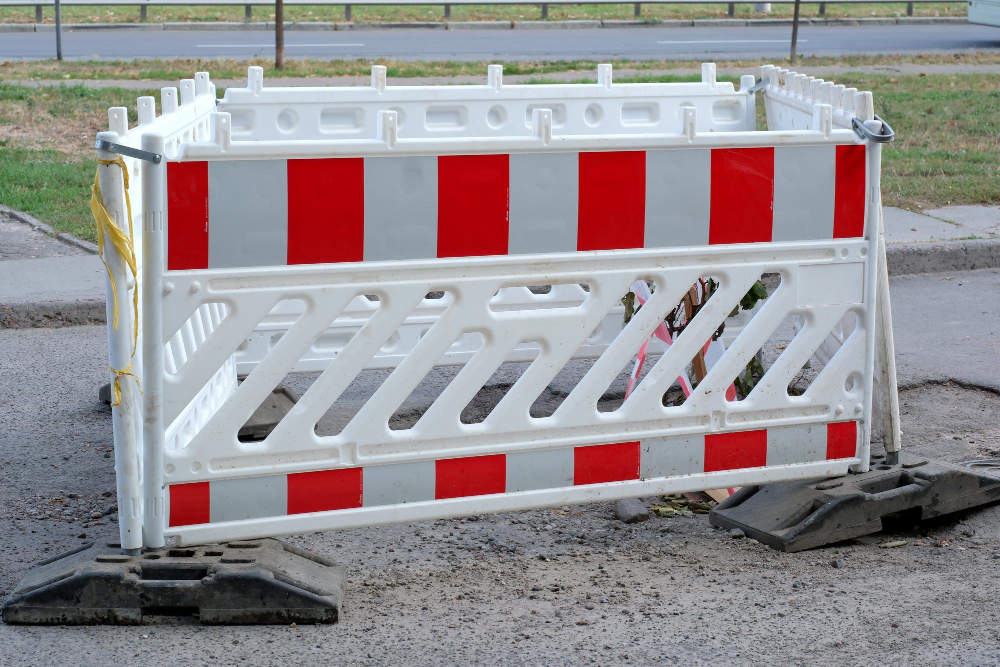
A sandbag is a consumable. Everybody who buys one knows it, prices it that way, and budgets to buy more. A rubber weight is equipment, which means you buy it once and it stays on the truck for years. The gap between those two ideas is the whole reason crews make the switch, and it is worth explaining why rubber actually earns that reputation rather than simply claiming it does.
Durability Comes Down to What Can Go Wrong
The way to think about service life is to count the failure points, since every part of a product that can wear, leak, rot, break, or come apart is another way for the product to die.
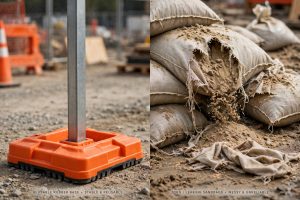
A sandbag has a long list of them. The fabric abrades against whatever it sits on, the weave opens up, the seams split under load, and the sand leaks out through any of those openings. Water soaks in and rots the material, sun makes it brittle, and frost expands the contents until the bag forces itself open. That is seven ways to fail before anyone counts the crew dragging it across asphalt at teardown.
A solid rubber weight has almost none of them. It is one piece of one material with nothing inside it, so there is no seam to split, no fabric to wear through, no contents to leak, and no cavity for water to get into. The list of things that can go wrong is very short, and that is the entire reason it lasts. Durability here is not about being tougher than the alternative, it is about having fewer ways to fail in the first place.
Recycled Rubber Was Already Built for This
The material matters, and it is worth knowing where it comes from. The Stand Box is molded from 96% compressed recycled rubber with a 4% compound, and that rubber started life as tires. Tires spend years outdoors on hot asphalt, in rain, through winters, taking impact and abrasion the entire time, which is the job the material was engineered for from the beginning.
So when a crew asks if rubber can handle sitting on a shoulder for a season, the honest answer is that the material has already done considerably harder work than that. Holding still on the ground is a retirement compared to what it did before. This is also why recycled rubber became the standard for outdoor weights rather than staying a novelty. It is not a compromise material chosen for the environmental angle, it simply happens to be the right material for the job, and keeping tires out of a landfill is a bonus on top of that.
No Water Absorption
Water is what kills most outdoor gear, and rubber does not let it in. A sandbag soaks, because the fabric holds moisture in the weave and the sand holds it in the mass, and the whole thing stays wet long after the rain stops. Wet means rot, mold, added load, and freeze damage, all arriving together.
Solid rubber gives water nowhere to go, so rain runs off rather than in. The unit weighs the same soaked as it does dry, which is not a small thing, because it means a crew can trust the number in any weather. Thirty pounds in July is thirty pounds in a November storm, and nobody has to think about it.
It also means storage stops being a problem. Wet sandbags in a closed trailer come out moldy and brittle in the spring, while rubber weights in that same trailer come out identical to how they went in. For a seasonal operator, that alone eliminates an entire replacement cycle. And because there is no air space inside the unit, the Stand Box will not float, which matters because a weight that floats in standing water has stopped being a weight and become debris.
Sun Does Not Win
Polypropylene bags go brittle under UV exposure, and it is one of the more reliable ways a sandbag dies. UV-treated fabric slows the process without stopping it, so the bag lasts longer and still ends up in the same place.
Rubber holds up considerably better under sun, which again traces back to what tires do for a living. A unit that lives outdoors year round stays intact rather than turning chalky and cracking apart. The practical version of this is that a rubber weight looks about the same in year three as it did in year one, since it gets dirty and scuffed without ever getting closer to falling apart.
Nothing to Refill Means Nothing to Neglect
This is the durability argument people miss, because it is about maintenance rather than materials. Sandbags need attention to keep working, since somebody has to notice the leak, get more sand, and top the bag off. In practice nobody does, because a leaking bag looks exactly like a working bag and there is always something more urgent happening on a site.
So the real service life of a sandbag is not how long the fabric lasts under ideal care. It is how long the bag takes to fail from neglect, which is a much shorter number, because neglect is the default condition on any busy job. A weight with nothing to refill cannot be neglected, since there is no maintenance step available to skip. The Stand Box weighs 30 pounds with or without anybody paying attention to it, which is the only realistic condition on most sites.
Built to Be Handled
Service life includes what happens during setup and teardown, and a surprising number of sandbags die right there. A brittle bag tears when a crew drags it, and a heavy wet one splits when somebody hauls it by the corner.
The Stand Box has a molded handle through the body, so it gets carried rather than dragged, and one person can pick it up in one hand, set it down, and move on to the next one. Equipment that is easy to handle correctly tends to get handled correctly, which removes an entire category of damage before it happens. The stacking design does the same job in storage, since interlocking knobs on top and matching holes on the bottom mean units stack and stay stacked in the trailer rather than shifting around and taking impact every time the truck turns a corner.
The Geometry Lasts Too
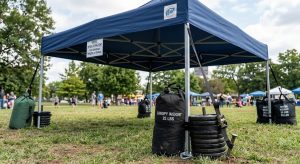
There is a version of failure that has nothing to do with wear, and rubber solves it permanently. A sandbag slumps as the sand settles and redistributes, sliding off the sign foot over a few days until it is sitting beside the base rather than on it. At that point the bag can be brand new and completely full and it still is not holding anything, because it is no longer connected to the frame.
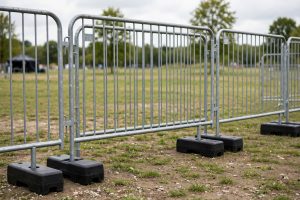
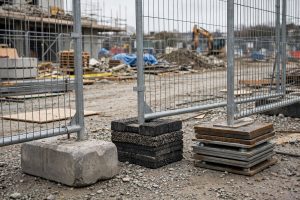
The Stand Box is molded with dual channels in the base that fit over the feet of temporary road signs and fence frames, so the weight drops onto the base and grips it. It cannot slump, settle, or migrate off center, because it is a solid shape locked onto a solid shape, and the fit on day one is identical to the fit in year five. That is a kind of durability that never shows up in a materials spec, and it is the one that keeps signs standing.
What Service Life Actually Buys You
A crew on sandbags buys bags in the spring, fills them, replaces the torn ones through the season, tops off the leakers when somebody gets to it, throws out the wet stock in the fall, and buys bags again the following spring. That is a recurring line item plus recurring labor, running forever, with no version of it that ever ends.
A crew on rubber buys weights once. The weights go out, come back, get stacked in the trailer, and go out again, and next season they do the same thing. The line item does not repeat.
The purchase price is $44.95 against a dollar or two for a bag, so the first invoice looks worse and there is no point pretending otherwise. The math turns over somewhere in the first year for most crews, and everything after that is upside. Add the cost of one sign that went down in a live lane because a bag had quietly emptied itself, and the timeline gets considerably shorter.
The Honest Limits
Rubber lasts a long time, and it is not indestructible, so a few things are worth knowing before anyone places a large order. It is heavy to ship, because it goes out at full weight rather than shipping flat and getting filled on site, which means freight costs more and a truck carries fewer units. For a crew working far from the yard, that is a real consideration.
It is also molded to fit specific hardware. The channels on the Stand Box fit standard temporary sign and fence feet, while a sandbag drapes over anything at all, and that flexibility is the one thing sand does better. If you run unusual hardware, confirm the fit before buying in volume rather than after.
Rubber can also be cut or gouged by something sharp enough, though it takes considerably more than what kills a bag, and it does not tend to happen in the course of ordinary work.
Moving Forward
Rubber weights last longer because there is less to go wrong. One solid piece, no fabric, no fill, no seams, no cavity, and no maintenance step for a crew to skip. The material spent its first life on tires taking worse punishment than any job site hands it, and the molded shape grips the base on day one and still grips it years later.
The Stand Box was built by Jodi Carter, a Marine Corps veteran who spent years replacing broken sandbags at a traffic control company before deciding the answer was to stop buying things that break. It is patented, made in the USA, molded from recycled material, and priced at $44.95 for a weight that gets bought once.