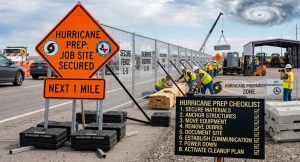

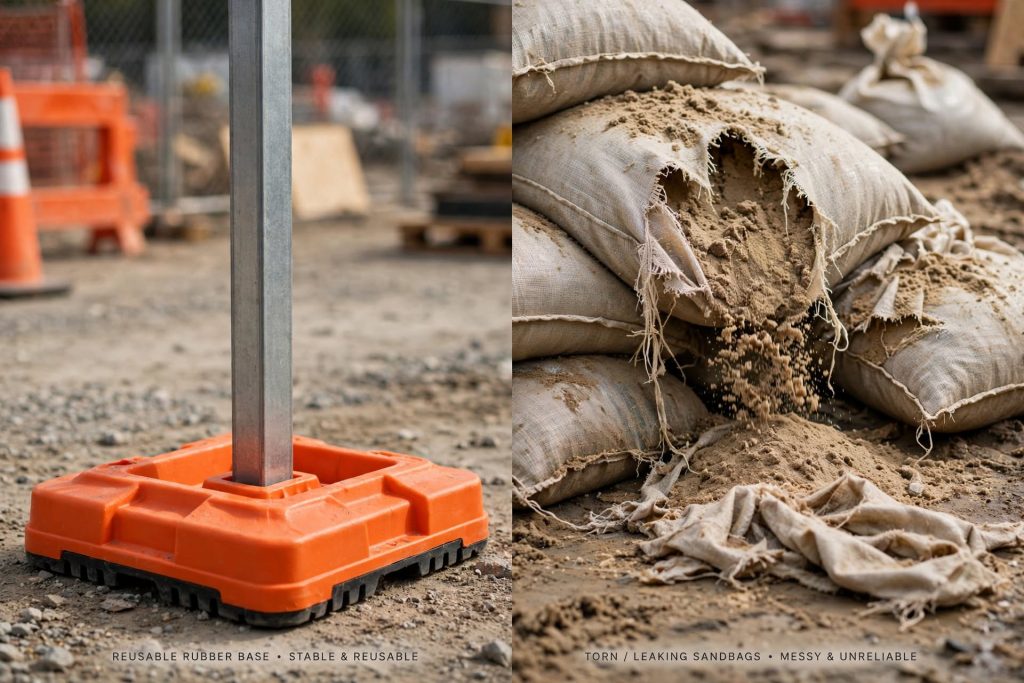
The appeal of a sign weight that doesn’t need refilling is easy to miss until you add up what refilling actually costs. A sandbag looks like the cheap option because the purchase price is a dollar or two, and that number is the only part most crews ever put on paper. The real cost of a sandbag is the cost of keeping it working, and that cost is spread across so many small tasks that it rarely gets counted. Here is the full tally that a no-refill weight removes.
The Purchase Price Is the Smallest Line
A bag costs a dollar or two, and sand is close to free, so a crew can weight a whole site for the price of lunch. That figure is what gets compared against a solid weight that costs more up front, and on that comparison sand wins every time.
The comparison is misleading, because a sandbag is not something you buy once. You buy it, fill it, refill it, replace it, and dispose of it, and only the first step ever shows up on an invoice. The rest hides inside labor and overhead where nobody adds it together, which is exactly why the true cost stays out of sight for years.
The Cost of Filling
Somebody has to put the sand in the bag, which means a person on the clock with a shovel doing work that produces nothing billable. This happens at the start of a project and again every time the stock runs low.
It is easy to wave off as a few minutes, but a crew filling a day’s worth of bags is spending real hours at a real labor rate, and those hours repeat all season. Nobody bills a client a line called bag filling, so it disappears into general labor and never gets questioned. Run the number for one crew across one season and it stops looking like a rounding error.
The Cost of Topping Off
A leaking bag is supposed to be topped off, and in practice it almost never is, because a leaking bag looks like a working bag and there is always something more urgent on a site. So the topping-off cost lands in one of two ways.
Either the crew does it, which is more shovel time nobody billed for, or the crew does not, which means the sign is underweighted and heading for the failure further down this list. There is no version where the leak is free. It is paid in labor or it is paid in a sign on the ground, but it is always paid.
The Cost of Replacement & Disposal
Bags do not last a season on hard duty. They tear, rot, go brittle, and split, and each one is a reorder. The reorders are small enough that they get approved without thought and never get totaled, but pull a year of purchase orders and the number is larger than anyone guessed.
Disposal is the second half of this. Wet bags come out of the trailer ruined in the spring and go to a dumpster, so the bag was paid for twice, once to buy and once to throw away. Sand that spilled across a site is its own small cleanup on top of that.
The Cost of the Failure You Did Not Catch
This is the one that dwarfs the rest. A sign or barricade goes down in a live lane because the weight holding it had quietly drained away. On a good day that is a callout and some hours. On a bad day it is a citation for an out-of-compliance work zone, and on the worst day it is a claim because a driver hit something that was not marked.
Any one of those can cost more than a full set of weights that would not have failed, and it traces straight back to a refill that never happened. The failure cost is the reason the invoice price of a sandbag has almost nothing to do with what a sandbag actually costs.
What a Sign Weight That Doesn’t Need Refilling Removes
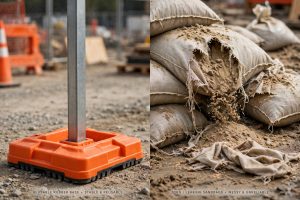
A solid weight with nothing inside it removes every line above at once. There is no filling, because it arrives at its weight. There is no topping off, because there is nothing to leak. There is no replacement cycle, because it does not tear or rot, and no disposal, because it does not get ruined in storage.
The failure cost drops sharply as well, because the weight still holds its number months later rather than drifting down while nobody watches. The purchase price is higher, and it is the only cost, paid once, against a sandbag’s small price paid over and over for as long as the crew keeps buying sand.
The Costs That Never Look Like Costs
Some of the refill cycle hides in places that never look like a line item at all. Sand has to be stored somewhere, which is yard space that could hold something that earns money. It has to be hauled to the site, which uses truck space and fuel on every trip. A crew loads and unloads it, moves it around the site, and handles it far more than a weight that gets set once and left.
None of that shows up as a cost of sandbags, because it shows up as general labor, as fuel, and as yard space nobody prices. A weight that arrives ready and gets reused removes all of it. It loads once, sets in seconds, and comes back to the truck at the end of the job with nothing to fill, dump, or store loose. The tasks are small enough one at a time that they never draw attention, and that is exactly why they add up unnoticed across a season.
Running the Number on Your Own Books
The way to settle this for your own operation is to stop comparing purchase prices and start comparing the full cost. Take a year of sandbag purchase orders, add the labor hours for filling and topping off at your loaded rate, add disposal, and look at how many resets or callouts traced back to a weight that had failed.
Put that total next to the one-time cost of solid weights that need none of it. For most crews doing regular outdoor work, the no-refill weight is cheaper inside the first year, and the gap only grows after that. The refill cost was always there. It was just never written on the page where anyone would see it.