Any supervisor who has run outdoor work for a few seasons has watched sandbags fail, usually more than once and usually at the worst time. The question of why sandbags fail on job sites is not a mystery once you have seen the pattern, because they fail in a handful of predictable ways that repeat from site to site. Knowing the five modes below makes it easier to catch a failure before it puts a sign in a lane, and easier to decide when sand is worth the trouble and when it is not.
Failure One: The Slow Leak
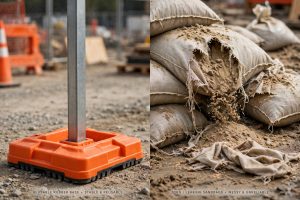
The most common failure is also the quietest. A bag tears a small opening on a metal sign foot, on gravel, or on a bolt head, and the sand starts working its way out a little at a time. Nobody sees it happen, because the bag keeps its shape and the sign keeps standing, so there is no reason to check.
A bag that held forty pounds in the spring can be down to twenty-five by late summer while looking exactly the same from a few feet away. The failure only shows itself when a gust arrives, the reduced weight is not enough, and the sign goes over. A supervisor who has dealt with this once learns to lift bags rather than look at them, because the eye cannot tell a full bag from a half-empty one.
Failure Two: The Blowout
The opposite of the slow leak is the sudden one. A seam lets go, a corner tears off, or the fabric splits along a worn line, and the sand is on the ground all at once. This tends to happen when a bag is overfilled, when it is already brittle from a season in the sun, or when a crew drags it across pavement during setup.
The blowout is easier to catch than the leak because it is obvious, and it is still a cost, because a burst bag has to be replaced and the sign is unweighted until someone gets to it. Barricade work sees the most of these, since the larger face rocks harder and grinds the fabric faster.
Failure Three: Water & Rot
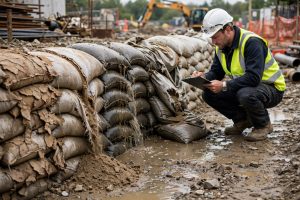
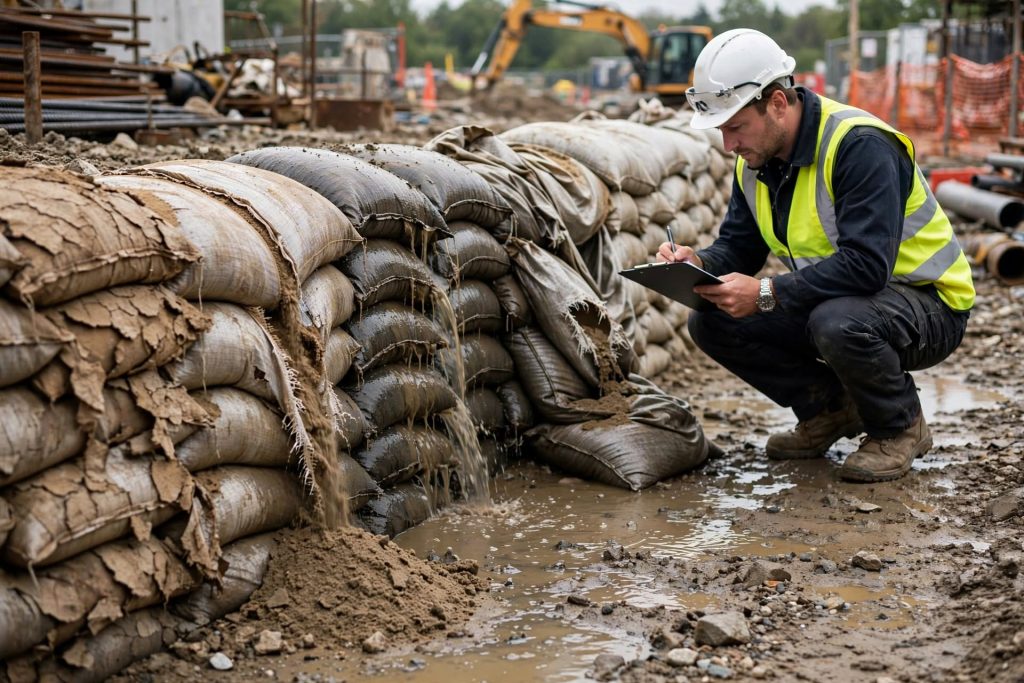
Rain is hard on a sandbag in more ways than one. Wet sand is heavier, which pushes a worn bag closer to a blowout, and the water soaks into the fabric and rots it from the inside. A bag that has been through a wet season is weaker than it looks, and one left sitting in standing water can float or slide off the base entirely.
Supervisors in wet climates learn that a weight which was fine in June is not the same weight in October, because the fabric has been soaking and drying the whole time. The bag does not announce that it has weakened, so the failure often arrives with the first storm that tests it.
Failure Four: The Weight That Walks Off
This one confuses people because the bag can be full and intact and still fail. A sandbag draped over a sign foot rests there rather than gripping it, and as the sand settles the bag slumps and slides until it is sitting beside the foot on the ground. Now the sign can lift and the bag stays where it is, contributing nothing.
The weight did not leak and did not tear, it simply was never connected to the thing it was meant to hold. A supervisor who finds a sign down next to a full sandbag has seen this mode, and it is the one no amount of better fabric can fix, because it is about how the weight sits rather than how it wears.
Failure Five: Death in Storage
The last mode happens when the bags are doing nothing at all. Wet bags packed into a trailer at the end of a season sit in the dark for months, and they come out moldy, brittle, and split. Cold climates add a freeze cycle, where water in the sand expands, forces the seams open, and drains the bag over the winter.
Either way, a supervisor opens the trailer in the spring and throws away a good share of the stock before the season even starts. This failure is invisible until the day it is discovered, which is usually the day the first job needs the weights and there is no time to replace them.
How to Spot a Failure Before It Drops a Sign
The value of knowing the five modes is catching them early, and each one leaves a sign a supervisor can read. A slow leak shows up when a bag feels lighter than it should, so the fix is to lift a sample of bags on a site rather than trusting how they look. A blowout leaves sand on the ground and an empty bag, which is obvious the moment anyone walks the line. Water damage shows in fabric that feels soft, stained, or brittle, and a bag that has been sitting in a puddle has usually already moved.
The weight that walks off is caught by looking at where the bag sits, not just that a bag is present, since a bag beside the foot is doing nothing. Storage failure is caught before the season starts by opening the trailer early rather than the day of the first job. A short walk with these five in mind turns a reactive morning of resets into a quick check that heads the problems off. The modes are predictable, which is the good news, because predictable failures are the ones a supervisor can get ahead of.
Why Sandbags Fail: The Common Thread
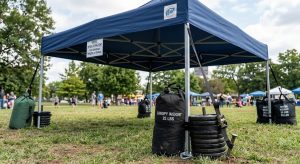
Every one of these five traces back to the same two facts. A sandbag is fabric, and it holds loose material. Fabric wears, tears, rots, and goes brittle, and loose material leaks, shifts, and settles off center. Fix those two facts and the failures go with them, which is why crews that switch to solid weights stop seeing most of this list. A solid weight has nothing to leak, nothing to rot, and can be molded to grip the base rather than rest beside it.
When Sand Still Makes Sense
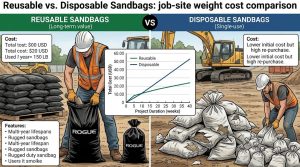
None of this means sandbags are useless. For a short setup in dry weather that comes down before anything changes, a bag does the job for very little money, and there is no reason to spend more. The failures above are a matter of time and weather, so a bag that is only out for a few dry days rarely reaches any of them.
The line to watch is duration and conditions. The moment a setup has to stand for weeks, sit through storms, or get reused season after season, the five modes start arriving on schedule, and that is where a weight built to avoid them earns its cost. A supervisor who knows the modes knows which jobs sand can handle and which ones it cannot.