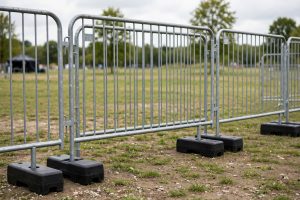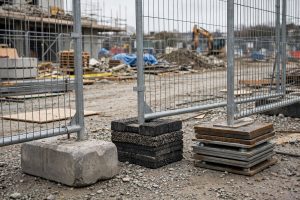

A run of temporary fencing is only doing its job while it is standing, and the thing keeping it upright is the weight on each foot. Choosing the right temporary fence weights is what separates a run that holds through a windy night from one the crew finds across the sidewalk in the morning. Sandbags have been the default for this for years, and they are also the reason a lot of fence runs come down. Here is how construction fencing actually fails and how to keep it standing without relying on sand.
A Fence Run Is One Connected Structure
The first thing to get right is that a run of fencing does not behave like a row of separate panels. The panels clamp together at the uprights, so ten panels in a line are mechanically one structure stretching a hundred feet or more. When wind loads that structure, the force does not stay where it lands. It travels along the run through the clamps and gathers at the weakest point.
That is why fencing fails as a run rather than one panel at a time. One foot gives up, that section leans, its load shifts to its neighbors, and the whole line goes over in sequence. The practical result is that a run is only as stable as its weakest foot, so putting weight on most of the feet and skipping a few leaves the run held up by the ones you skipped.
Why Sandbags Struggle on Fencing
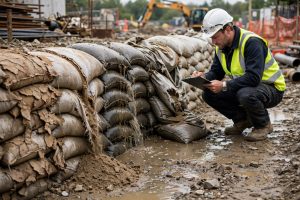
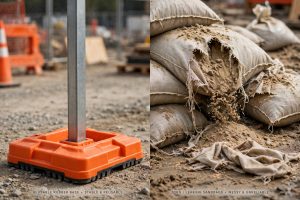
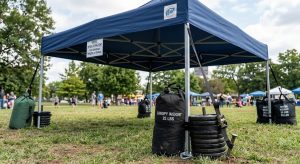
Sandbags are cheap and available, which is the entire reason they lasted this long on fence duty. The trouble shows up over a season. A bag draped over a fence foot rests there rather than gripping it, and as the sand settles the bag slumps and slides off center until it is sitting beside the foot on the ground. At that point the panel can lift and the bag stays put, contributing nothing.
The bag also leaks. The fabric wears open on the metal foot or on gravel, and the sand works out a little at a time until a bag that was holding forty pounds is now holding half of that. Rain soaks the fabric and it rots, and bags left through a freeze usually split and drain. So the weight you placed in the spring is often not the weight that is there when the wind arrives, and nobody notices because a slumped, half-empty bag looks about the same as a full one from a few feet away.
What Good Temporary Fence Weights Do
The job of a fence weight comes down to two things. It has to hold a known amount, and it has to stay connected to the foot. A weight that is heavy but sits loose beside the foot does nothing the moment the panel lifts, which is the same failure that sends a loose sign into a lane.
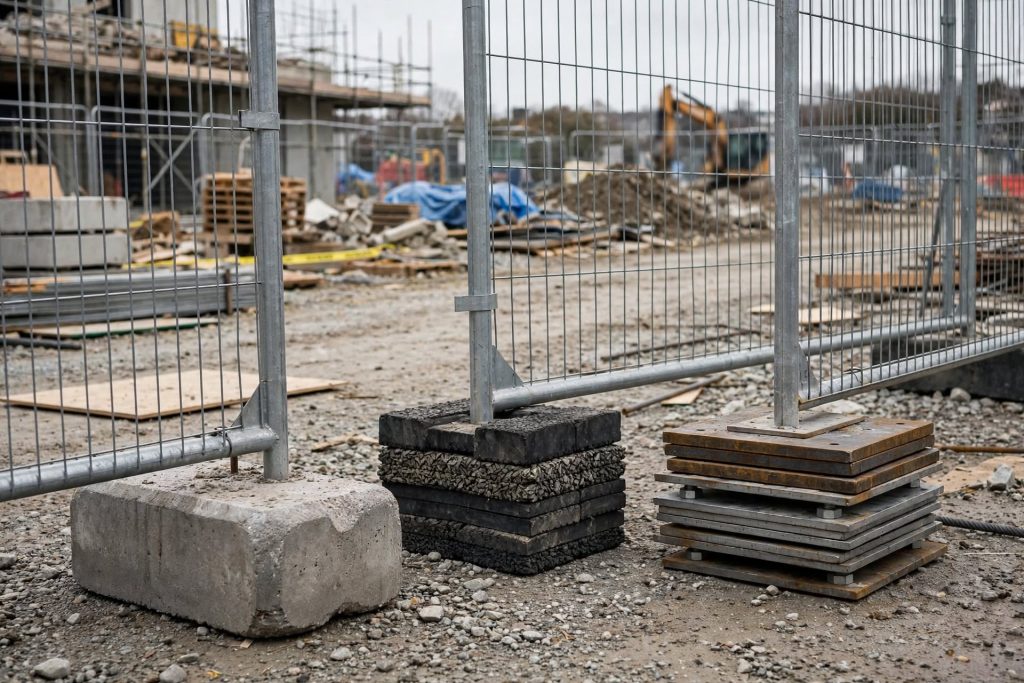
Solid weights that are molded to fit over a fence foot can handle both at once. They lock onto the base, so the weight and the panel move as one piece, and a gust that would have lifted a loose panel has to lift the weight with it. Because the weight is solid, it holds the same mass for years with nothing to leak, so the number you placed is still the number that is there when it counts. That combination of holding the mass and gripping the foot is what a sandbag cannot manage on a fence run.
Weight on Every Foot, Not Every Third One
Because a run fails at its weakest point, the rule is to weight every foot rather than spacing weights out to save units. A crew that weights every third foot has built a run that fails at the bare ones, and the bare feet are where the wind goes looking. This is the single most common reason a run that seemed secure comes down.
Stacking matters here as well. A run facing real wind often needs more than one unit on a foot, and weights that lock together let a crew build up the hold exactly where a panel pulls hardest. A stack that stays locked holds through a gust, while a loose pile of bags slides apart under the same load. Being able to add weight in a form that stays put is what lets a crew match the ballast to the conditions instead of hoping the standard amount is enough.
Watch What the Panels Are Wearing
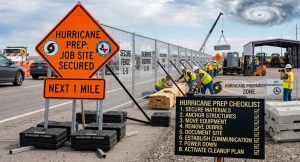
One thing changes the wind load on a fence faster than anything else, and that is screen. Bare chain link is mostly holes, so wind passes through it and the run is not under heavy pressure. Add privacy screen, windscreen, or debris netting and the panel becomes a solid surface that catches wind like a sail.
The load on that same fence goes up sharply, and it does so on a run that was anchored for the open version. This is the most common surprise on a fence line, because the screen went up for privacy or dust control and nobody revisited the weights afterwards. If you add a screen to a run, you have built a different fence, and it needs more weight on every foot to match.
Keeping Construction Fencing Stable
Putting it together, a stable run comes down to a short list. Treat the run as one structure that fails at its weakest foot, so put weight on every foot rather than skipping any. Use weights that grip the foot instead of resting beside it, so the connection survives the moment the panel lifts. Pick ballast that holds its mass over a season rather than draining away unnoticed, and add weight wherever a run is exposed or wearing a screen.
Then walk the line before the weather arrives and look for the foot somebody missed, because there is usually one, and it is the foot that decides how the run holds up overnight. Do that, and construction fencing stays where the crew set it without the refilling and resetting that sandbags build into the job. A run that is weighted right the first time is one less thing to chase down after a storm.