
Crews working through a northern winter tend to write off their sandbag stock every spring, and most of them treat that as normal. The bags go out in the fall holding what they should, they sit through a few months of freezing and thawing, and by March half of them are split, empty, or too brittle to pick up without tearing. Nobody investigates it because it happens every year and it has always happened every year. The interesting part is that freezing does not damage a sandbag the way most people assume, and knowing what actually goes on inside the bag makes it clear why no amount of better fabric solves it.
Water Is the Problem, Not Cold
Cold on its own does very little to a bag of dry sand. If you could keep sand genuinely dry through a winter, it would sit at twenty degrees below zero and come out in the spring exactly as it went in. Sand is rock that has already been ground down as far as it goes, and cold does not bother it.
The trouble is that a sandbag on a job site is never dry. Fabric wicks moisture out of the ground and holds it in the weave, rain and snowmelt soak straight through, and the sand itself holds water between the grains once it gets in. By the time a hard freeze arrives, a bag that has been sitting outdoors for a few weeks is carrying a meaningful amount of water distributed all through it, and that water is what does the damage.
What Happens When It Freezes
Water expands when it turns to ice, which is unusual among common materials and is the reason frozen pipes burst and potholes open up every spring. Inside a sandbag, that expansion has nowhere useful to go. The sand grains are already packed against each other, so as the water between them freezes, it pushes the grains apart and the whole mass swells against the inside of the bag.
The bag is now under pressure from within, and it is under that pressure at the worst possible time, because cold fabric is stiff fabric. Polypropylene that would stretch and absorb the load on a summer afternoon has very little give at twenty degrees. It cannot flex out of the way, so the pressure finds the weakest line and opens it, which is almost always a seam.
The bag also freezes to whatever it is sitting on. A bag on a sign foot becomes locked to that foot in a block of ice, and a crew that comes along to move the sign kicks it, pries it, or hauls it loose. The fabric tears where it was frozen down, and the crew has just destroyed a bag that survived the freeze itself.
The Cycle Is Worse Than the Freeze
A single hard freeze rarely finishes a bag. What finishes it is doing that fifty times. Most winters are not a steady deep cold. They are a long series of freezes and thaws, where the temperature crosses back over the line every few days or sometimes twice in one day. Each crossing runs the same cycle again. The water expands and pushes the sand outward against stiff fabric, then it thaws, the mass loosens, and the sand settles into whatever new shape it now occupies. Any small opening that appeared during the freeze is now a path for sand to escape as the bag shifts and resettles.
That is the real mechanism. The freeze creates the opening, and the thaw uses it. Run that cycle through a full winter and the bag has been slowly worked apart from the inside, opened a little at a time, and drained a little at a time, without anybody ever seeing a dramatic failure. The bag that comes out in April is not the one that went in.
Why Spring Stock Is Always Bad
This is why the annual write-off happens, and why it is so consistent that most shops budget for it without thinking.
Everything that went wrong through the winter was invisible. The bags sat on site or in a trailer, nobody was weighing them, and the failures were internal. Seams opened under ice pressure. Sand worked out through those openings during thaws. Fabric that spent months cold and wet lost whatever flexibility it had. The bags did not look different in any way that would prompt a crew to check.
Then spring arrives, somebody goes to move the stock, and it comes apart in their hands. Bags tear when they are lifted. Bags that look full turn out to be half empty. Bags that were fine in November are trash in March.
The cost of this is not just the replacement order, though that is the part that shows up on paper. It is also that for the last several months of winter, every one of those signs was being held down by a weight that had already partly failed, and nobody knew. Winter work zones ran on weights that were quietly getting lighter through the worst weather of the year, which is exactly when they needed to be at full strength.
Why Better Bags Do Not Fix It
The obvious response is to buy heavier stock, and it is worth being clear about what that does and does not accomplish.
A heavier weave and a stronger seam will survive more freeze cycles than a cheap bag will. UV-treated fabric that has not already gone brittle from summer sun starts winter in better shape and lasts further into it. Those are real improvements and they push the failure date later.
They do not remove the failure, because the mechanism is not the bag being weak. The mechanism is that the bag contains water and the water expands. Any container that holds wet loose material through a freeze is fighting the same force, and the only question is how many cycles it takes to lose. A better bag loses in three winters instead of one, which is progress, but it is still on the same path to the same place.
What Does Not Care About Winter
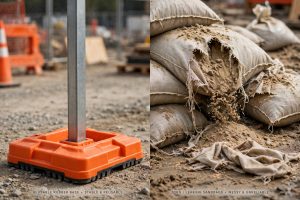
The way out is a weight with no water in it and nothing inside that can expand. The Stand Box is a single piece of compressed recycled rubber, 96% recycled material with a 4% compound, molded at 30 pounds. There is no fabric to go stiff, no seam to open, no cavity for water to collect in, and no loose material inside that could freeze into an expanding mass. Rain runs off it rather than into it, so when the temperature drops there is nothing in the unit for the cold to work on.
The material itself has a relevant history. It started as tires, which spend their working lives outdoors through winters, on cold roads, flexing at temperature and taking impact the entire time. Sitting on a sign foot through a freeze is not a challenge for a material that used to do that at seventy miles an hour.
The practical result is that the unit that comes off a site in April is the unit that went on in October. It weighs 30 pounds in both months, because it weighed 30 pounds when it was made and there is no mechanism available for that to change. The annual spring write-off simply stops being a line in the budget, and more to the point, the work zones running through February are held down by weights at full strength rather than weights somewhere in the middle of failing.
Quick Recap
Sandbags do not fail in winter because it is cold. They fail because they are full of water, and water expands when it freezes, and stiff cold fabric cannot get out of the way. Then the thaw lets the sand out through whatever opened, and the cycle runs again a few days later and keeps running until spring.
If you work through winters and you replace your bags every year, that is not bad luck or bad bags. That is the design meeting the weather and doing exactly what it was always going to do. The only way off the cycle is a weight that has nothing inside it to freeze.