

Thirty pounds is the common answer for a standard portable sign stand in normal conditions, and it is the size most crews reach for. It is also not the answer to your question, because the number that governs your setup comes from the stand you are running and the agency you are working under, not from a rule of thumb. Here is how to find the figure that actually applies, and why the weight alone matters less than most people assume.
Start With the Stand Manufacturer
Sign stand manufacturers publish ballast requirements for their products. They tested the stand, they know what it takes to hold it, and that specification is the closest thing to a real answer available to you. It is worth pulling before anything else, because it costs nothing and it settles the question for the equipment you already own.
The requirement will vary by stand. A lightweight roll-up stand and a heavy framed unit do not need the same ballast, and a manufacturer who builds both will tell you so. If you run several stand types across your fleet, the number is different for each, which is a good reason to check rather than standardize on a guess.
Then Check Your Agency
If you are working on a public road, the agency in charge sets requirements that override anything you decided on your own. State departments of transportation publish specifications for temporary traffic control devices, and those specifications frequently cover ballast. Local municipalities and project owners add their own on top.
The MUTCD and the guidance built on it govern how work zone devices are used, and agencies adopt and extend that guidance in their own manuals. If a specification applies to your job, that is the number, and it does not matter what a supplier or a forum told you. Find it before the setup rather than after an inspection.
Why Thirty Pounds Comes Up So Often
Thirty pounds is common because it lands in a useful window rather than because it is a magic figure. It is heavy enough to hold most standard portable sign stands against ordinary wind, which covers a large share of the work crews actually do. It is also light enough that one person can carry it in one hand and place it without help or equipment. That second half matters more than people credit, because a weight that is awkward to move is a weight the crew stops using. Sixty pounds in a single unit would hold better and would also sit in the truck while somebody dragged a sandbag over instead.
The Stand Box is built to that logic at 30 pounds with a molded handle through the body, which is what makes it a one-hand placement on a shift where a crew is setting dozens of signs.
Weight Is Only Half the Question
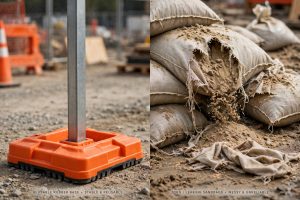
Here is the part that gets missed, and it matters more than the poundage does. A weight has to be connected to the thing it is holding, and a sandbag draped over a sign foot does not grip anything. It rests there, and the sand settles and redistributes until the bag slumps off center and ends up beside the foot rather than on it. When wind lifts the sign, the frame comes out from under a bag that is no longer on it, so the bag stays on the ground and the sign goes over. That bag can be brand new, holding a full forty pounds and it still contributed nothing at the moment it was needed.
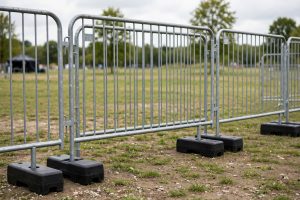
The Stand Box is molded with dual channels in the base that fit over the feet of temporary road signs and fence frames, so the weight drops onto the foot and locks to it. When wind pushes the sign, the weight and the frame move as one piece, which means they do not move at all. Thirty pounds locked onto a base outperforms fifty pounds resting near one, because the connection is doing more work than the mass is.
So if you are asking how heavy a sign weight should be, the more useful question is how much weight is actually attached to the sign. Those are different numbers on most job sites and only one of them is holding anything up.
When You Need More Than One
Some setups need more than a single unit, and the stand specification plus experience with your own sites will tell you which. A large sign face is a large sail, and a framed sign at highway speed takes a hit from every truck that passes, so high wind, exposed sites, and long-duration setups all point toward adding weight. The important part is being able to add it in a way that stays added, since stacking sandbags does not work well and the pile comes apart under the first load that hits it. Interlocking knobs on top and matching holes on the bottom let units stack and lock together, so sixty pounds is still sixty pounds when the gust arrives rather than two separate weights sliding in opposite directions.
The Number You Think You Have
There is one more issue worth raising, because it undermines every calculation above.
If you are running sandbags, you probably do not have the weight you think you have. Bags leak from the day the fabric opens on a metal sign foot or a piece of gravel, and the sand runs out a few ounces at a time. A bag that held 40 pounds in March is holding 25 by August, and nothing about it looks different from ten feet away.
So a crew can do the math correctly, specify the right ballast, place it properly, and still have an underweighted sign, because the number on the spec sheet and the number on the ground stopped matching months ago. This is the argument for a solid weight that has less to do with the initial figure than with keeping it. The Stand Box weighs 30 pounds the day it arrives and 30 pounds years later, wet or dry, because there is nothing inside it that could leave.
The Short Version
Pull the specification from your sign stand manufacturer and check the requirement from the agency you are working under, then build to whichever number is higher. Thirty pounds handles most standard stands in normal conditions and is the size most crews use, though it is a starting point rather than an answer.
More important than the figure itself is that the weight is locked onto the sign foot rather than sitting beside it, and that it still weighs what it did when you bought it. A crew that gets both of those right rarely has a sign problem. A crew that gets either one wrong will keep resetting the same sign no matter what the spec sheet says.