
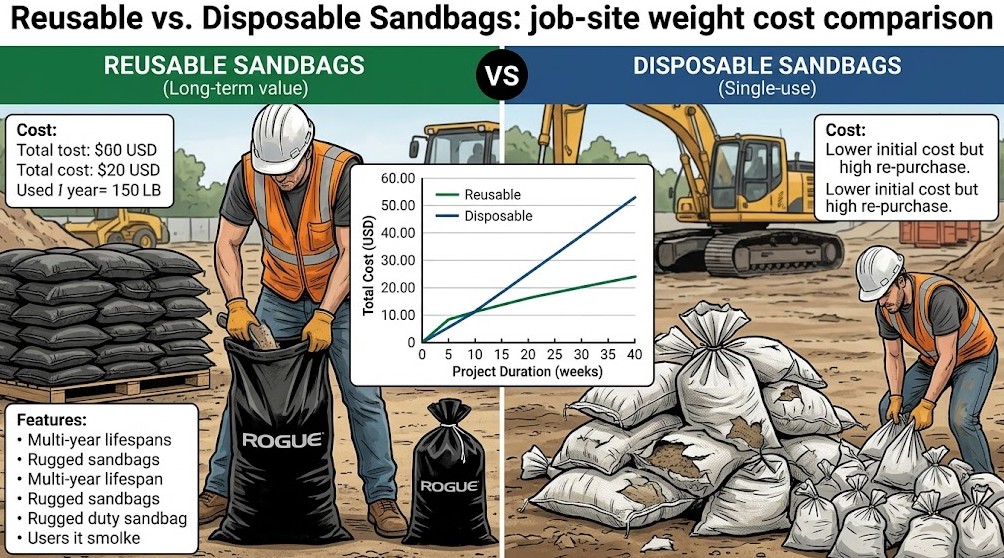
Sandbags are often viewed as one of the cheapest ways to stabilize temporary job-site equipment. The problem is that the purchase price is only one part of what contractors actually spend. Filling, transporting, replacing, cleaning up spilled material, and disposing of damaged bags can add recurring costs throughout the year.
For contractors using temporary weights repeatedly, comparing reusable vs. disposable sandbags based on total annual cost can reveal a very different picture.
Reusable vs. Disposable Sandbags: The True Cost Over a Year of Job Sites? — Short Answer
Disposable sandbags can have a lower upfront cost, but their total annual cost may increase with replacement, fill material, labor, transportation, cleanup, and disposal. Reusable job-site weights typically require a larger initial investment but can be used across multiple projects. For frequent users, calculating cost per deployment provides a more useful comparison than comparing unit prices alone.
A reusable option such as The Stand Box TX can help contractors standardize temporary weighting while reducing dependence on loose-fill materials.
The important question is not simply, “How much does one sandbag cost?” It is “How much does this weighting method cost every time we deploy it?”
Why the Cheapest Sandbag Isn’t Always the Cheapest Option
The difference between purchase price and total cost
The purchase price is only the starting point. A realistic calculation can include:
- Initial bag purchases
- Sand or other fill material
- Filling labor
- Transportation
- Replacements
- Storage
- Cleanup
- Disposal
A bag that costs less initially may become more expensive if it needs to be replaced repeatedly.
Why job-site frequency changes the economics
A contractor using ten sandbags once a year has a very different cost profile from a company deploying hundreds of bags across multiple projects every month.
Frequency matters because every additional deployment creates another opportunity for labor, handling, deterioration, and replacement costs.
The hidden cost of repeatedly replacing sandbags
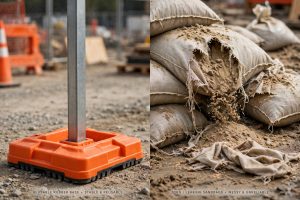
Outdoor job sites can be hard on fabric bags. Tears, seam failures, wet fill, abrasion, and lost sand can turn a reusable-looking sandbag into a consumable.
Replacement also takes employee time. Someone has to identify the damaged bag, obtain another one, fill it, transport it, and position it.
What Makes Disposable Sandbags Expensive Over a Year?
Initial sandbag purchase
Annual consumption depends on how many bags are needed per project and how many projects are completed. Bag quality also varies, meaning service life cannot be assumed to be identical across all products.
Sand and filling costs
Sandbags require fill material and preparation. Depending on the operation, this can involve purchasing, loading, transporting, filling, and positioning sand.
Replacement frequency
Rain, UV exposure, rough surfaces, dragging, and repeated handling can accelerate deterioration. Damaged seams or punctures may cause fill material to escape.
Labor and handling costs
Employees may spend time filling, moving, repositioning, emptying, and replacing bags. These activities can become significant when temporary weights are used frequently.
Cleanup and disposal
Broken bags and spilled sand can create additional cleanup work. Damaged materials may also need to be removed from the job site.
What Makes Reusable Job-Site Weights More Cost-Effective?
One investment across multiple projects
A reusable weighting system can move from one project to another rather than being purchased and discarded repeatedly.
This can be especially relevant for contractors with recurring temporary stabilization requirements.
Consistent weight and handling
Purpose-built reusable weights can provide standardized units, making inventory planning easier. Contractors know what equipment is available instead of relying on whatever bags or fill material happen to be on hand.
Reduced filling and emptying
Solid reusable weights eliminate the need to repeatedly fill and empty loose material. This can reduce preparation time and simplify deployment.
Storage and transportation considerations
Stackable reusable weights can make inventory management easier. Contractors should still evaluate vehicle capacity, storage space, handling requirements, and the weight of each unit before purchasing.
Reusable vs. Disposable Sandbags: The True Cost Over a Year of Job Sites?
Build a realistic annual cost model
A simple comparison can start with these formulas:
Annual Disposable Cost = Initial Bags + Replacement Bags + Fill Material + Labor + Transportation + Cleanup + Disposal
Annual Reusable Cost = Initial Weight Investment + Transportation + Storage + Maintenance
Actual costs vary by contractor, labor rates, number of projects, replacement frequency, and deployment conditions.
Example: Occasional job-site use
For a contractor using a small number of sandbags only a few times per year, disposable bags may remain practical. The limited number of deployments may not justify a larger reusable investment.
Example: Frequent contractor use
A contractor repeatedly installing barricades, signs, temporary fencing, or other equipment has more opportunities to spread the cost of reusable weights across multiple deployments.
Example: Multiple crews using temporary weights
For companies operating several crews, standardized reusable inventory can simplify allocation, transportation, and equipment tracking.
Reusable vs. Disposable Sandbags: Annual Cost Comparison
| Cost Factor | Disposable Sandbags | Reusable Job-Site Weights |
|---|---|---|
| Initial cost | Lower | Higher |
| Replacement | Potentially recurring | Typically lower with proper maintenance |
| Fill material | Required | Not required for solid weights |
| Filling labor | Yes | No |
| Emptying labor | Often | No loose fill |
| Cleanup | Potential | Generally reduced |
| Storage | Can become dirty or wet | Designed for repeated storage |
| Reuse | Depends on condition | Designed for repeated use |
| Cost per deployment | Can increase over time | Can decrease with reuse |
| Best fit | Occasional/short-term use | Frequent/repeated applications |
Why annual cost matters more than unit price
Compare one deployment first. Then compare ten. Then fifty.
The more frequently a weighting solution is deployed, the more important its recurring handling and replacement costs become.
This is the foundation of lifecycle economics: a higher initial price can potentially become more economical when the product is repeatedly reused.
What Factors Increase the True Cost of Disposable Sandbags?
Weather exposure
Rain, moisture, sunlight, and temperature changes can affect fabric and fill material.
Frequent handling
Dragging, lifting, loading, unloading, and repositioning increase physical wear.
High-wear job sites
Construction debris, rough surfaces, sharp edges, and heavy equipment can increase the chance of punctures or tears.
Long-duration deployments
Bags left outdoors for weeks or months may experience more environmental exposure than bags used for a short project.
How to Calculate Your Annual Sandbag Cost
Step 1: Count how many sandbags you currently use
Record the average number of bags used per project and your number of annual projects.
Step 2: Determine how often you replace them
Track replacements monthly, quarterly, or by project.
Step 3: Calculate annual fill-material costs
Include sand purchases, delivery, loading, and handling.
Step 4: Estimate labor
Include filling, transportation, positioning, replacement, and cleanup.
Step 5: Add transportation and disposal
Account for vehicle space, storage, removal, and disposal costs.
Step 6: Compare against reusable inventory
Use:
Annual Cost ÷ Number of Deployments = Approximate Cost Per Deployment
This provides a straightforward way to compare different weighting systems.
Step-by-Step Guide: How to Decide Between Disposable and Reusable Weights
Step 1: Determine how frequently you use job-site weights
The more frequently you deploy weights, the more important lifecycle cost becomes.
Step 2: Calculate your current annual sandbag consumption
Record purchases and replacement quantities instead of estimating from memory.
Step 3: Identify replacement and failure points
Determine whether bags are failing because of weather, abrasion, handling, or storage.
Step 4: Calculate labor and handling costs
Estimate the employee time associated with filling, moving, replacing, and cleaning bags.
Step 5: Account for storage and transportation
Consider where materials are stored and how they are moved between projects.
Step 6: Estimate reusable weight cost per deployment
Divide the reusable equipment investment across expected deployments.
Step 7: Compare total annual ownership cost
Look beyond the initial purchase price.
Step 8: Choose based on lifecycle value
Occasional users may prefer disposable options, while frequent contractors and multi-site operations may have a stronger case for reusable equipment.
The Stand Box TX: A Reusable Alternative to Disposable Sandbags
What makes The Stand Box TX different?
The Stand Box TX’s product is a reusable weighting option designed for repeated temporary stabilization applications. Its 30-lb design uses solid recycled rubber rather than loose sand.
Key characteristics include:
- 30-lb weighting option
- Solid reusable construction
- No loose sand required
- Molded handle
- Stackable design
- Designed for repeated handling
Why reusable weights can simplify job-site operations
Instead of repeatedly filling and emptying bags, contractors can maintain an inventory of reusable units and move them between suitable applications.
That can simplify storage, deployment, and equipment planning while reducing dependence on loose-fill materials.
The Stand Box TX should still be selected according to the specific equipment, application, and manufacturer’s requirements.
Where Reusable Weights Can Deliver the Most Value
Construction sites
Reusable weights can be used for suitable applications involving:
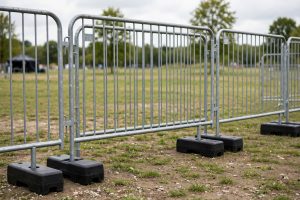
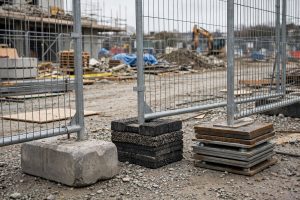
- Barricades
- Temporary signs
- Temporary fencing
- Traffic-control equipment
Event operations
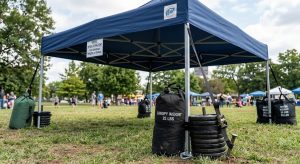
Event companies may use temporary weights for tents, canopies, barricades, and displays.
Contractors with multiple projects
Reusable inventory can move between job sites, allowing the same equipment to support multiple projects.
Businesses with frequent setup and teardown
When equipment is repeatedly installed and removed, eliminating filling and emptying can simplify operations.
When Disposable Sandbags May Still Make Sense
One-time or very short-term projects
Limited use may not justify investing in reusable equipment.
Emergency applications
Sandbags can be useful when immediately available materials are needed.
Situations where sand is already available
Existing fill material can reduce the incremental cost of using sandbags.
Very low-frequency users
Businesses that rarely need temporary weights may prioritize low initial expenditure.
Projects where initial cost is the primary consideration
Reusable does not automatically mean cheaper for every project. The correct choice depends on usage frequency and total operating costs.
Common Mistakes When Comparing Sandbags and Reusable Weights
Comparing only the purchase price
The initial price does not show the full cost of ownership.
Ignoring labor
Filling and replacing bags requires employee time.
Forgetting replacement frequency
A low-cost bag that requires frequent replacement can become expensive.
Ignoring transportation and storage
Both fill material and finished weights require space and transportation.
Overlooking cleanup costs
Spilled sand and damaged bags can create additional work.
Failing to calculate cost per use
Annual cost becomes much easier to understand when converted into a per-deployment figure.
Assuming all sandbags have the same service life
Material quality and site conditions can vary considerably.
Assuming every reusable weight is suitable for every application
Weighting requirements depend on the equipment and application. Manufacturer specifications should always be checked.
How to Reduce the Annual Cost of Job-Site Weighting
Standardize your weighting inventory
Use consistent equipment where practical to simplify deployment and training.
Track replacement rates
Record damaged and discarded sandbags to identify recurring costs.
Store reusable weights correctly
Proper storage can help protect reusable equipment between projects.
Inspect weights between projects
Identify damage before equipment reaches the next job site.
Reduce unnecessary transportation
Plan equipment movement alongside normal project logistics.
Calculate cost per deployment
Use annual expenses divided by deployments to identify the actual operating cost.
Replace recurring consumables with reusable equipment where practical
Where temporary weights are used frequently, reusable equipment may reduce repeated material and labor costs.
Frequently Asked Questions About Reusable vs. Disposable Sandbags
Are reusable weights cheaper than sandbags?
Not necessarily at the point of purchase. Reusable weights generally have a higher initial investment, while their potential economic advantage comes from repeated use and reduced recurring costs.
How long do reusable job-site weights last?
Service life depends on material construction, handling, environmental exposure, storage, maintenance, and manufacturer specifications. There is no universal lifespan that applies to every reusable weight.
Are disposable sandbags really cheaper?
They can be cheaper for occasional or short-term use. For frequent deployments, however, replacement, labor, fill material, and cleanup can significantly affect their total annual cost.
What are the hidden costs of sandbags?
Common additional costs include sand, filling labor, transportation, replacement, cleanup, storage, and disposal.
What is the best alternative to sandbags for construction sites?
Purpose-built reusable weights can be an alternative for suitable applications. The correct choice depends on the equipment being stabilized and its manufacturer’s requirements.
Can The Stand Box TX replace sandbags?
The Stand Box TX can serve as a reusable weighting option for suitable temporary stabilization applications. Whether it can replace a particular sandbag application depends on the equipment, required weight, attachment method, and manufacturer specifications.
How do you calculate the cost of sandbags over a year?
Add initial purchases, replacements, fill material, labor, transportation, cleanup, and disposal. Then divide the annual total by the number of deployments to estimate cost per use.
Are reusable weights worth it for contractors?
Frequent users generally have more opportunity to benefit from reusable equipment because the initial investment can be distributed across many deployments. Contractors should compare their actual annual costs before making a decision.
Reusable vs. Disposable Sandbags: The True Cost Over a Year of Job Sites? — Final Verdict
The real cost of sandbags is rarely limited to the price printed on the receipt. Over an entire year of job sites, contractors may also pay for replacement bags, sand, filling labor, transportation, storage, cleanup, and disposal.
Disposable sandbags can still make sense for occasional, short-term, or emergency applications. But businesses that repeatedly stabilize temporary equipment should evaluate reusable job-site weights based on total cost of ownership and cost per deployment.
The Stand Box TX offers a 30-lb reusable option for suitable temporary stabilization applications, providing solid recycled-rubber construction without loose fill and with features designed for repeated handling and storage.
Ultimately, the cheapest weight to buy is not necessarily the cheapest weight to operate. For contractors using job-site weights repeatedly throughout the year, the real question is how much each deployment costs, not simply what each unit costs at checkout.