
A portable sign stand stays upright on a calm day with very little holding it down. The test comes when the wind picks up, and that is when sign weights for windy days stop being an afterthought and start deciding where your sign ends up. Too little ballast and the stand walks or tips into a lane. The right amount, connected the right way, keeps it where you set it through the gusts it was going to see anyway. Here is how to work out the number your stand actually needs.
How Wind Loads a Sign
A sign face is a flat panel held up in the air, which makes it a small sail. Wind pushing on that face does two things at once. It presses the whole stand backward, and it tries to lift the upwind side of the base off the ground. The taller the sign and the larger the face, the more leverage the wind has against the feet.
Roll-up signs on spring stands flex and spill some of that load, which helps a little. Rigid framed signs do not, so they carry the full push straight down to the base. Either way, the force arrives in gusts rather than a steady pressure, and a gust is what finds the weak point in a setup. A stand that holds through a steady breeze can still go over when a truck passes and drags a wall of air behind it.
Where the Real Number Comes From
The honest answer to how much ballast a stand needs is that the stand tells you, not a blog and not a supplier. Sign stand manufacturers publish ballast figures for their products, and those numbers come from testing the actual stand rather than guessing. That specification is the first thing to pull, and it costs nothing to find.
If the work is on a public road, the agency in charge sets requirements that override anything you decided on your own. State departments of transportation publish specifications for temporary traffic control devices, and many of them cover ballast directly. The federal guidance that those manuals build on assumes the device is standing, so keeping it upright is treated as part of meeting the standard. When a specification applies to your job, that figure governs, and it is worth finding before a setup rather than after an inspector points it out.
Why a Rule of Thumb Falls Short
Crews trade numbers because they are easy to remember, and a figure that worked on one stand in one spot gets repeated far from where it came from. The problem is that a sign face on a tall stand in an open field is a different load from a low sign on a sheltered street, and the same weight does not answer both situations.
A rule of thumb is a starting point rather than a specification. It is fine for a rough plan, and it is not something to lean on when a sign going down would put a hazard in a live lane. Pulling the actual figure takes a few minutes and removes the guesswork from a setup that has real consequences when it fails.
Weight Is Only Half the Job
Here is the part that matters as much as the number and gets far less attention. A weight only works if it stays connected to the stand.
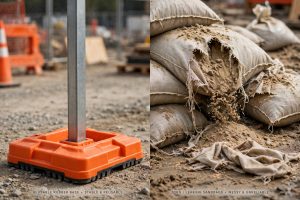
A sandbag draped over a foot rests there rather than gripping it. As the sand settles, the bag slumps and slides off center until it is sitting beside the foot on the ground. When a gust lifts the sign, the frame comes up out from under a bag that is no longer on it, and the bag stays put while the sign goes over. That bag could be holding its full weight and still do nothing, because it was never attached to the thing it was meant to hold.
Solid weights that are molded to fit over the feet of a stand behave differently. They lock onto the base, so the weight and the frame move together, and a gust that would have lifted a loose sign has to lift the weight along with it. On a windy day, a smaller weight that grips the base often outperforms a larger one that only rests near it.
Keeping the Number You Started With
There is a second reason a correctly weighted sign still goes down, and it has nothing to do with the math. The weight you placed may not be the weight that is there now.
Sandbags leak from the day the fabric opens on a metal foot or a piece of gravel, and the sand escapes a little at a time. A bag that held forty pounds in the spring can be holding twenty-five by late summer, and nothing about it looks different from a few feet away. So a crew can specify the right ballast, place it properly, and still end up with an underweighted sign, because the number on the ground drifted down over months while nobody was watching.
Solid weights hold their mass because there is nothing inside them to escape. A molded weight that reads thirty pounds on the day it arrives still reads thirty pounds years later, wet or dry. That consistency is worth as much on a windy day as the initial figure, since the figure only helps if it is still true when the wind arrives.
Sign Weights for Windy Days in Practice
Put the pieces together and a working method comes out of it. Start with the stand manufacturer’s ballast figure and check the agency requirement for the road you are on, then build to whichever number is higher. Add weight for a large sign face, an exposed site, or a long setup, and add it in a form that stacks and stays put rather than a pile that slides apart.
Make sure the weight grips the foot instead of resting beside it, and make sure the weight still holds what it is supposed to hold rather than trusting how it looks. A crew that gets the number right, keeps the weight connected, and uses ballast that does not drain itself over a season rarely spends its mornings resetting the same sign. Windy days stop being the thing that undoes the setup and become one more condition the setup was built for.