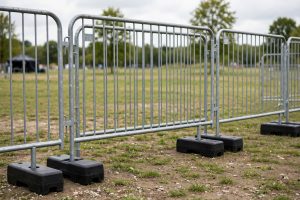

Crowd barriers at an outdoor event have one job, which is to stay exactly where the crew set them and hold a line that people lean on, push against, and walk past all day. The event barricade weights holding each section down are what keep that line from drifting into a lane or folding under a crowd. Wind makes it harder, and so do the people the barrier is there to manage. Here is how temporary barriers fail at events and how to secure them so they hold through the day.
What a Barrier Is Up Against at an Event
An event barrier faces two forces at once, and they are different from what a barricade sees on a quiet road. The first is wind, which pushes on the flat face of the barrier and tries to walk it sideways or tip it. The second is the crowd. People lean on a barrier, push against it during a busy moment, and set bags and drinks on the top rail, and all of that load lands on a barrier that is only as stable as its base.
A barrier that shifts a few inches at a time looks fine until the gap it opens lets someone through or the line it was holding drifts into a space it should not. At an event, a barrier going down is not only a setup problem, it is a safety one, because the whole point of the barrier was to keep people where they are supposed to be.
Why Sandbags Fall Short at Events
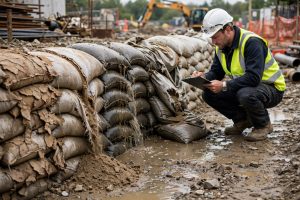
Sandbags are common at a lot of events, and events are hard on them in ways a road is not. The bags get dragged across pavement during load-in and load-out, the fabric wears open, and the sand starts leaking. A bag that held its weight at the first event of the season is lighter by the middle of it, and nobody weighs it between jobs.
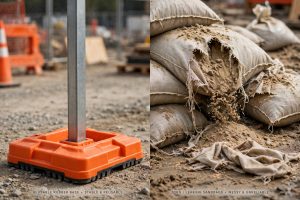
There is also the look of them. A row of split, stained sandbags along a barrier line at a public event is not the impression most organizers want to leave, and event work happens in front of the crowd and the client. On top of that, a sandbag draped over a barrier foot rests there rather than gripping it, so when wind or a crowd surge lifts or shoves the barrier, the bag stays on the ground and the barrier moves without it. Between the leaking, the appearance, and the loose fit, sandbags leave a barrier line less stable than it looks.
What Good Event Barricade Weights Do
A weight built for event barriers has to do three things. It has to hold a known amount, it has to stay connected to the barrier foot, and it has to look like professional equipment rather than a pile of ruined bags. The first two are the ones that keep the barrier standing, and the third is the one organizers notice.
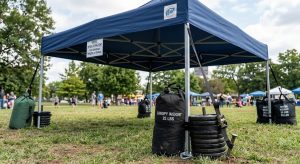
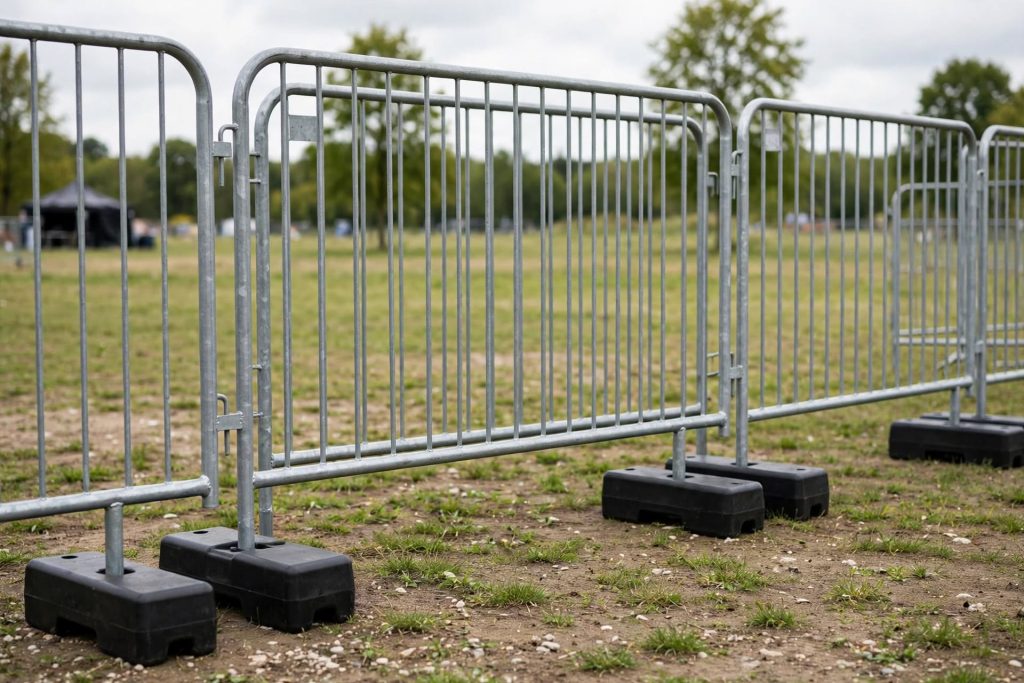
Solid weights that are molded to fit over a barrier or fence foot grip the base rather than resting beside it, so the weight and the barrier move together when something pushes on them. Because the weight is solid, it holds its mass for years with nothing to leak, so the number the crew placed is the number that is there at the next event and the one after that. A weight that grips, holds, and looks clean is one a crew can set once and trust through a long day.
Secure Every Section, Not Just the Windward End
A barrier line, like a fence run, is a connected structure that fails at its weakest point. The sections link together, so a push or a gust travels along the line and finds the section with the least holding it down. Weighting the ends and skipping the middle leaves a line that folds in the middle, and weighting only the windward side leaves the rest to follow once the first section goes.
The rule is to weight every section rather than spacing the weights out to save units. For a line facing real wind or a heavy crowd, stacking units on a foot lets a crew build up the hold where the load is highest, and weights that lock together hold through a surge where a loose pile would slide apart. Matching the weight to the section that needs it most is what keeps the whole line standing rather than the strongest part of it.
Plan for the Surface & the Weather
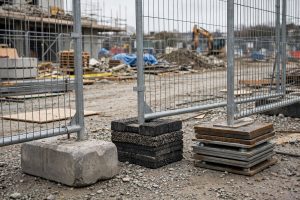
Most event barriers go up on pavement, turf, or a finished plaza where stakes are not an option, so the weights are doing all the work. On a smooth surface, a weight that does not grip anything can slide, taking the barrier with it, so a solid weight with a base that grips holds far better than a bag that skates on wet pavement.
Weather is the other factor. Rain soaks sandbags, rots them, and leaves them moldy in storage, and the day it rains is usually the day it is also windy, so the ballast is failing at the same moment the load peaks. Solid weights that shed water hold the same on a dry day and a soaked one, which removes a variable an outdoor event cannot plan around. Checking the forecast and the surface before load-in tells a crew how much weight each section needs rather than finding out during the event.
Keeping the Line Standing Through the Day
Putting it together, a secure barrier line comes down to a short routine. Treat the line as one structure that fails at its weakest section, so weight every section rather than skipping any. Use weights that grip the foot instead of resting beside it, pick ballast that holds its mass over a season, and add weight wherever the wind, the crowd, or the surface calls for more.
Then walk the line before the gates open and look for the section somebody under-weighted, because that is the one a crowd surge or a gust will find. A barrier line weighted right the first time holds through the day without a crew chasing it between acts, and it keeps the people it was set up to manage where they are supposed to be.