For most outdoor work, yes. For a short job in dry weather, no, and anyone who tells you otherwise is selling something. The honest answer depends on how long the setup has to stand and what the weather is going to do to it, so here is the full picture rather than the sales version.
The Short Answer
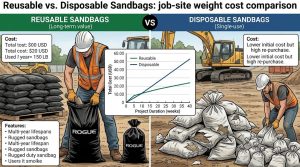
A rubber weight holds a known amount of mass for years without any maintenance, while a sandbag loses mass quietly from the day it is filled. If your setup stands for more than a few weeks, sits through rain or wind, or has to be reset by the same crew every week, rubber is the better tool and the difference is not close.
If your setup goes out for three dry days in July and comes down before anything changes, a sandbag does the job for a dollar or two and there is no reason to spend more than that.
Why Rubber Wins on Anything That Lasts
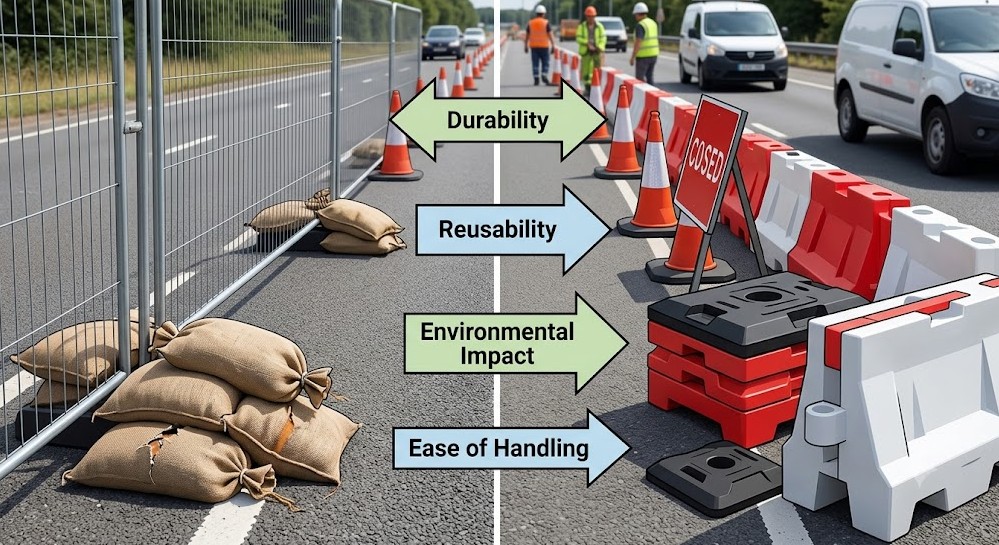
The core problem with a sandbag is that it is fabric holding loose material, and both halves of that description are working against you. The fabric tears on gravel, on metal sign feet, and on bolt heads, and once the weave opens the sand starts leaving a little at a time. A bag that held 40 pounds in March is holding 25 by August, and nothing about it looks different from ten feet away. That is the part that makes sandbags genuinely worse rather than simply cheaper, since the failure is invisible until a sign goes down.
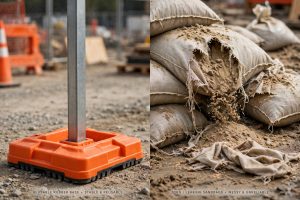
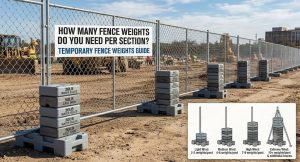
A rubber weight has nothing inside it to leave. The Stand Box is molded from 96% compressed recycled rubber with a 4% compound, so it is one solid piece with no seam, no fill, and no cavity. It weighs 30 pounds the day it arrives and 30 pounds years later, wet or dry, in sun or frost. A crew that knows every weight on site is 30 pounds can plan a setup around a real number, while a crew running sand is working from an estimate that quietly gets worse every month.
The Part Most Comparisons Miss
Weight is only half the job, and the half people argue about is usually the less important one. A weight also has to be connected to the thing it is holding down.
A sandbag draped over a sign foot does not grip anything, it rests. The sand settles and redistributes, the bag slumps, and over a few days it works its way off center until it is sitting beside the foot rather than on it. When wind lifts the sign, the frame comes out from under a bag that is no longer on it, so the bag stays on the ground and the sign goes over. That bag can be brand new and completely full and it still contributed nothing.
The Stand Box is molded with dual channels in the base that fit over the feet of temporary road signs and fence frames, so the weight drops onto the base and locks to it. When wind pushes the sign, the weight and the frame move as one piece, which means they do not move at all. Thirty pounds locked onto a base outperforms fifty pounds resting near one, because shape does more work here than mass does.
Where Sandbags Genuinely Win
There are real advantages on the sand side and they are worth naming, because a comparison that only lists one product’s strengths is not useful to anyone deciding.
Sandbags are cheap, at a dollar or two against $44.95 for a solid weight, and that gap is real money when a crew needs two hundred of them. They are available anywhere on no notice, which matters when a job comes up suddenly. They ship flat and get filled on site, so freight costs almost nothing, while rubber ships at full weight and a truck carries fewer units. A bag also molds to whatever shape it sits on, while a molded weight fits the hardware it was designed for, so crews running unusual equipment should confirm the fit before ordering in volume. For a short dry job, that combination is difficult to beat and there is nothing wrong with taking it.
The Cost Question
The purchase price is the only part of the sandbag cost that anybody tracks, and it is the smallest part of the total. Bags get filled by somebody on the clock, hauled, topped off when they leak, replaced when they tear, and thrown away when they come out of the trailer moldy in the spring. Every one of those is labor or money, and all of it hides inside other line items where nobody ever adds it together.
Then there is the failure cost, which does not appear on any invoice at all. A sign down in a live lane means a callout at minimum, and possibly a citation or a claim, and that single event can cost more than a full set of weights that would not have failed.
The way to settle this for your own operation is to pull twelve months of purchase orders and add up every line that says sandbag, then add the labor hours for filling and topping off at your loaded rate, then look at your incident history and count the resets that traced back to a weight that had already failed. Put that number next to the one-time cost of solid weights. For most crews doing regular outdoor work, the crossover happens inside the first year, and everything after that is clear.
So Which Should You Buy?
Buy sandbags when the job is short, the weather is dry, and the setup comes down before anything changes. Buy rubber when the setup stands for weeks, when storm season is running, when the site floods, when the same crew resets the same signs every week, or when a sign going down would create a real hazard. That covers most traffic control work, most construction, and most event work.
Plenty of shops keep both on hand, using bags for the quick dry jobs and solid weights for everything that has to hold. That is a reasonable answer and it is probably the most common one among crews who have run the numbers honestly.