
Yes, and that is most of the reason crews end up buying more of them than they planned to. A solid weight bought for road signs does not stay on road signs. It migrates to the fence line, then to the tarps, then to the tent legs, and eventually somebody is using one as a tire chock and asking where the rest of them went. Here is what one unit actually covers and where the limits sit.
Why One Weight Covers So Much
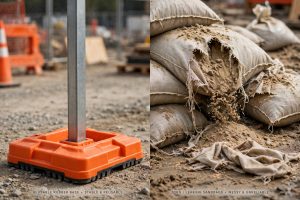
A sandbag does one job and does it poorly over time, which trains crews to think of weights as job-specific consumables. A solid weight is a different category of object. It is 30 pounds of dense material with a handle and a molded base, and any situation that calls for holding something down outdoors is a situation it fits.
The Stand Box was designed around road signs, since that is the problem its founder was solving at a traffic control company in Colorado. The base is molded with dual channels sized for the feet of temporary road signs and fencing, which is where the design work went. What crews found afterward is that a solid 30 pound block with a handle solves a long list of problems that have nothing to do with signs.
Signs & Barricades
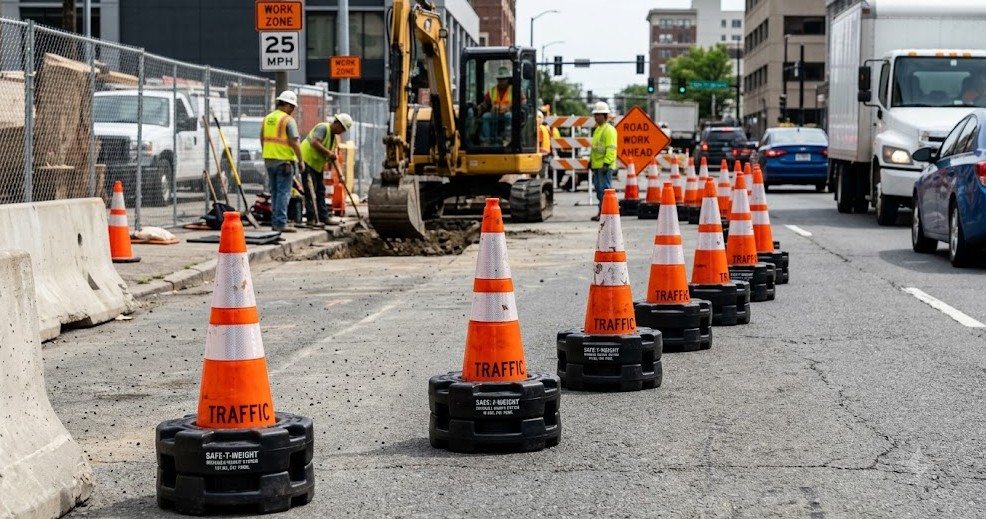
This is the core use and the one the channels were built for. The weight drops onto the foot of a temporary sign stand or a barricade base and locks to it, so the weight and the frame move as one piece rather than the frame lifting out from under a weight that stayed on the ground. Type I, Type II, and Type III barricades, portable sign stands, detour markers, and lane closure signage all take the same unit.
Temporary Fencing
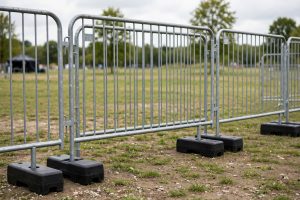
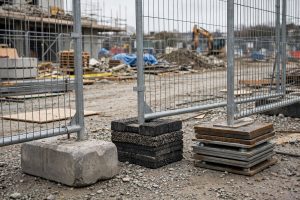
The same channels fit fence feet, which makes this the second use most crews find. A fence run is mechanically one long structure, so the load travels along it and concentrates at whichever foot is weakest, which means weighting every foot matters more than weighting most of them. The unit that came off a sign goes onto a fence foot without any adaptation.
Tent & Canopy Ballast
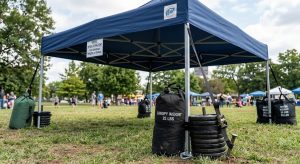
For tents the unit works differently. It is placed upright on the foot of each leg and secured to the frame rather than using the base channels, since the channels are sized for sign and fence feet rather than tent legs. Used that way it functions as ballast for EZ-Up frames and commercial canopies where staking is not an option, which covers most paved event sites.
Tarps & Coverings
Wind gets under an edge and peels a cover off a material stack, and weights placed around the perimeter stop it. Rubber has an advantage here beyond simply being heavy, since a split sandbag with a hard seam can abrade a tarp while a smooth molded block does not.
Around the Yard & the Site
This is where the list gets long and slightly unpredictable. Crews use them as tire chocks, as anchors for small boats, as hold-downs for patio furniture, and stacked into temporary steps. The interlocking knobs on top and matching holes on the bottom are what make the step and riser work at all, since a stack that slides apart is not something anyone should stand on.
None of those were the design intent. They are what happens when a crew has a solid, stackable 30 pound block on the truck and a problem in front of them.
Why Versatility Is Not Just a Convenience
There is a cost argument buried in this that matters more than the novelty of the list. A weight that only does one job has to be justified against that one job. A weight that does six jobs gets used six times as often, which changes the math on the purchase price. The Stand Box is $44.95, which is a real number next to a dollar or two for a bag, and the way that number gets absorbed is by the unit earning its cost across several uses rather than sitting in a bin waiting for sign season.
It also simplifies what a crew carries. One item on the truck covers signs, fencing, tarps, and tents, rather than three types of ballast and a pile of bags. For an operator loading a trailer every weekend, that is fewer decisions and less inventory.
Where the Limits Are
Being honest about this matters, since a page claiming a product does everything is a page nobody believes.
The base channels are molded to fit standard temporary sign and fence feet. They fit what they were designed to fit, and a crew running unusual hardware should confirm the fit before buying in volume rather than after. This is the one place a sandbag genuinely wins, because a loose bag drapes over any shape at all.
Thirty pounds is 30 pounds. Some applications need more, and the answer there is stacking units rather than expecting one to do work it cannot. Some applications need less, and a 30 pound block is overkill for holding down a picnic tablecloth.
The unit is also not an engineered anchor for anything with a published anchoring specification. Tents have manufacturer ballast requirements and permit minimums, and those govern. The weight is a known 30 pound building block you use to reach whatever number applies, not a substitute for finding out what that number is.
And it is heavy to move around, which is the entire point but is worth remembering. Thirty pounds is a one-hand carry by the molded handle, and a hundred of them is a pallet.
Key Takeaway
One weight covers signs, barricades, fencing, tarps, tent legs, tire chocks, and a running list of things crews find on their own. The base channels handle sign and fence feet directly, the unit goes upright for tent ballast, and the stacking design lets you build to whatever weight a setup calls for.
The limits are real and short. It fits the hardware it was molded for, it weighs what it weighs, and it does not replace reading the specification for anything that has one. Within those limits, it is one of the few items on a truck that gets used for something on nearly every job.