
Yes. Rubber weights are built to live outdoors year round, and leaving them out is the normal way to use them rather than a compromise. Sun, rain, snow, and freezing temperatures do not break them down the way those same conditions destroy a fabric sandbag over a single season. Here is what actually happens to a rubber weight left outside, and where the honest limits are.
Why the Material Handles It
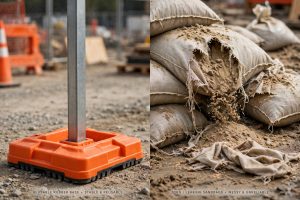
The Stand Box is molded from 96% compressed recycled rubber with a 4% compound, and knowing where that rubber came from answers most of the durability question on its own. It started life as tires, which spend years outdoors on hot asphalt, through rain, across winters, taking impact and abrasion the entire time at highway speed. That is the job the material was engineered for from the beginning, so when somebody asks if rubber can survive sitting on a shoulder through a season, the honest answer is that the material has already done considerably harder work than that.
This is also why recycled rubber became the standard for outdoor weights rather than staying a niche product. It is not a compromise material chosen for the environmental angle. It happens to be the right material for outdoor use, and keeping tires out of a landfill is a bonus on top of that.
Water Does Not Get In
Water is what kills most outdoor gear, and a solid rubber weight gives it nowhere to go. Rain runs off rather than soaking in, because there is no fabric weave to hold moisture and no cavity for it to collect in.
The practical result is that the unit weighs the same when soaked as it does dry. That sounds like a small detail and it is not, because it means a crew can trust the number in any weather. Thirty pounds in July is thirty pounds in a November storm, and nobody has to think about it or check.
Compare that to a sandbag, which holds moisture in the weave and in the sand itself and stays wet long after the rain stops. Wet fabric rots, wet sand adds load the bag was never rated for, and the whole thing goes brittle once the sun finishes it off. None of those failure paths exist on a solid weight.
Because there is no air space inside it, the Stand Box also will not float. That matters more than people expect, since a weight that floats in standing water has stopped being a weight and become debris. On a flooded shoulder, in a filled trench, or through a storm, the unit stays where the crew put it.
Sun Does Not Win
Polypropylene sandbags go brittle under UV exposure, and it is one of the most reliable ways a bag dies. A bag that flexed when it came out of the box turns stiff and chalky after a season in the open, and UV-treated fabric only slows that process rather than stopping it.
Rubber holds up considerably better under sun, which again traces back to what tires do for a living. A unit that lives outdoors year round stays intact rather than turning chalky and cracking apart. The practical version is that a rubber weight looks about the same in year three as it did in year one. It gets dirty and it gets scuffed, and neither of those brings it any closer to failing.
Freezing Does Not Split It
Cold is where sandbags come apart, and the mechanism is worth knowing because it explains why rubber is immune to it. A sandbag on a job site is never dry, since the fabric wicks moisture out of the ground and rain soaks straight through, so by the time a hard freeze arrives the bag is carrying water all through the sand. Water expands when it freezes, and inside a packed bag that expansion has nowhere useful to go, so it pushes the sand outward against fabric that is cold, stiff, and unable to stretch, and the seams open under that pressure. Then it thaws, the sand loosens, whatever opened becomes a path for sand to escape, and the cycle runs again a few days later.
A solid rubber weight has no water in it, so there is nothing available for the cold to work on. The unit that comes off a site in April is the unit that went on in October, weighing the same in both months, because there is no mechanism by which that could change.
Storage Is Not a Problem Either
Leaving weights outside is one question and storing them between seasons is another, and rubber handles both. Wet sandbags packed into a trailer at the end of a season come out moldy, brittle, and split, because damp fabric in a dark closed space is an ideal place for things to grow, and every one of those bags gets replaced in the spring.
Rubber weights sit in that same trailer for six months and come out identical to how they went in. There is no moisture in them to feed anything, no weave to trap the organic debris that growth needs, and no fabric whose fibers could break down. The interlocking knobs on top and matching holes on the bottom also mean units stack into a stable block rather than a loose heap that shifts every time the truck takes a corner.
The Honest Limits
Rubber lasts a long time and it is not indestructible, so a few things are worth knowing.
It can be cut or gouged by something sharp enough, though it takes considerably more force than what destroys a bag and it does not tend to happen in the course of ordinary work. It will get dirty, scuffed, and faded over years of sun, and while none of that affects how it performs, a unit that has been outside for five seasons looks like it has. And it is heavy to move around, at 30 pounds per unit, which is the entire point but is worth remembering when planning storage.
What This Means in Practice
The reason this question comes up at all is that crews are used to weights being consumable. With sandbags, leaving them outside is what kills them, so the instinct is to ask what the maintenance routine looks like for the alternative. There is not one. A rubber weight goes out, stays out, and comes back the same, with nothing to inspect, nothing to dry, nothing to top off, and nothing to throw away at the end of the season. That is less a claim about the material being tough than an observation that there is very little on a solid weight that could go wrong in the first place.