
No. There is nothing inside a rubber weight to refill, which is the whole point of the design and the single clearest difference between a solid weight and a bag of sand. A sandbag is a container, and containers are empty. A rubber weight is a solid object, and solid objects do not.
That answer takes one sentence, so the more useful question is what refilling actually costs when it is part of the routine, and why removing the step matters more than it first appears.
What Refilling Costs on a Sandbag
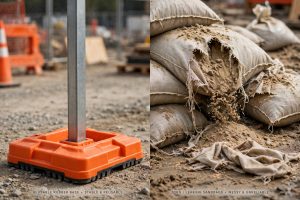
Sandbags leak from the moment the fabric opens, and it opens sooner than most crews expect. A bag on a sign foot grinds against a metal edge every time the wind rocks the sign, and gravel and broken asphalt cut it from underneath. Once the weave parts, sand starts leaving a few ounces at a time.
The correct response is for somebody to notice, get more sand, and top the bag off. In practice that almost never happens, and the reason is not carelessness. A leaking bag looks exactly like a working bag, and the sign is still standing, so on a site with a hundred things demanding attention there is no signal telling anyone to check. Nobody walks in a work zone lifting sandbags to feel how heavy they are.
So the refilling cost shows up in one of two ways, and neither one is free. Either a crew does it, which is labor that gets billed to something and produces nothing, or a crew does not do it, which means the sign is being held by 25 pounds that everybody believes is 40. That second version is the one that puts a sign in a traffic lane on a windy Tuesday.
The Maintenance Step Nobody Performs
This is the part worth sitting with, because it changes how the comparison works. The real service life of a sandbag is not how long the fabric lasts under attentive care. It is how long the bag takes to fail from neglect, which is a much shorter number, because neglect is the default condition on any busy job. Every product that requires maintenance is really two products: the one in the brochure that gets maintained, and the one on the site that does not.
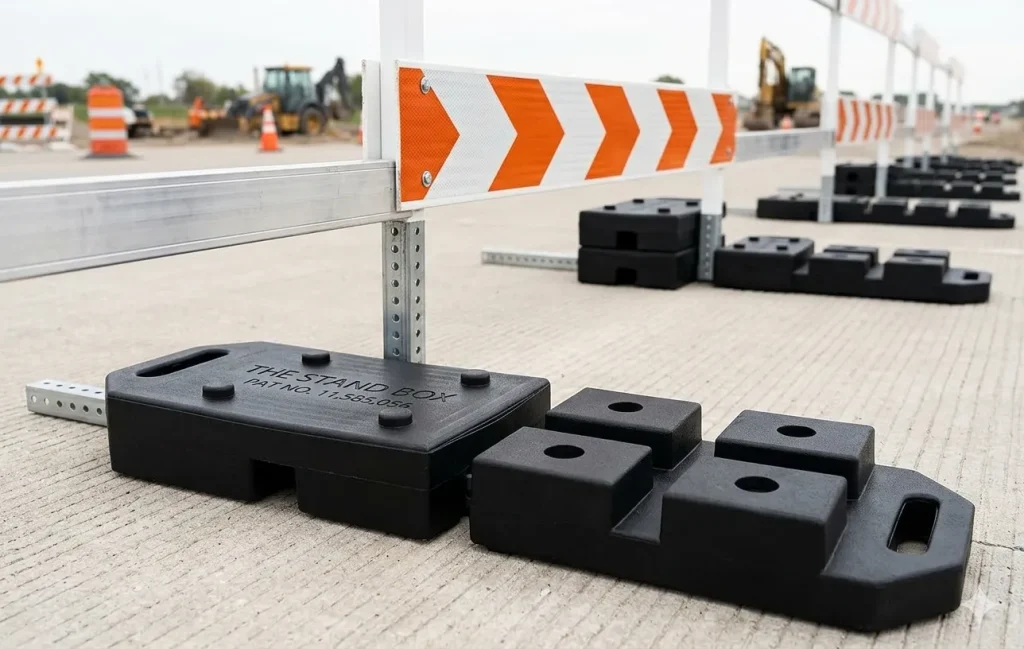
A weight with nothing to refill cannot be neglected, since there is no maintenance step available to skip. The Stand Box weighs 30 pounds with or without anybody paying attention to it, which is the only realistic condition on most sites. That is not a claim about rubber being a superior material so much as an observation that removing a step removes every failure that step was preventing.
What the Unit Is Made Of
The Stand Box is molded from 96% compressed recycled rubber with a 4% compound. It is one piece of one material, with no seam, no fabric, no fill, and no cavity.
There is nothing inside it that could leak out, nothing that could settle, and nothing that could be topped off even if somebody wanted to. It weighs 30 pounds the day it arrives and 30 pounds years later, wet or dry, in sun or frost. A crew that knows every weight on site is 30 pounds can plan a setup around a real number, while a crew running sand is working from an estimate that quietly gets worse every month.
What Else Goes Away With the Refilling
Removing the refill step removes a chain of other work that came attached to it, and most of that work is invisible on any invoice.
There is no filling in the first place, which means nobody stands at a sand pile with a shovel doing work that produces nothing. There is no sand pile to store, no sand to haul, and no filling station to maintain. There is no stock of empty bags waiting to be filled and no stack of split ones behind the shop.
There is also no disposal. Wet sandbags go into a trailer at the end of a season and come out moldy and brittle in the spring, which means every one of them was paid for twice, once to buy and once to haul away. Rubber weights sit in that same trailer for six months and come out identical to how they went in.
And there is no inspection routine, because there is nothing to inspect. Nobody has to lift bags to gauge their weight or turn them over to look for holes in the underside. The weight is the weight.
Does It Ever Need Anything?
Not in any meaningful sense. It will get dirty and it will get scuffed, and after several seasons of sun it will look like something that has been outside for several seasons. None of that affects how much it weighs or how well it holds, and there is no maintenance schedule attached to it.
Rubber can be cut or gouged by something sharp enough, though it takes considerably more force than what destroys a fabric bag and it does not tend to happen in the course of ordinary work. If a unit does get damaged badly enough to matter, it is still a solid block that weighs what it weighs, since there is no fill to escape through the damage.
Why This Is the Whole Argument
Nearly every complaint crews have about sandbags traces back to the fact that a bag is a container holding loose material. It leaks because the container opens. It gets heavy and rots because the container absorbs water. It floats because the container has air in it once the sand starts leaving. It splits in a freeze because the contents expand and the container cannot stretch. And it needs refilling because the contents leave.
Remove the container and remove the contents, and every one of those failures goes with them. What is left is a piece of rubber that weighs 30 pounds, and the only thing anyone has to do with it is put it where it belongs.
The Short Version
Rubber weights do not need refilling, because there is nothing in them to refill. That single fact removes filling, topping off, replacing, storing sand, hauling sand, disposing of ruined stock, and inspecting weights to find out what they actually weigh.
The purchase price is higher than a bag and there is no way around that. What you buy with it is a number that stays the same for years without anyone doing anything to keep it there.