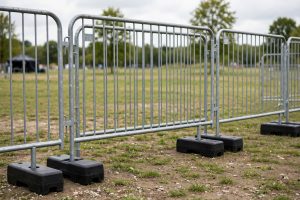

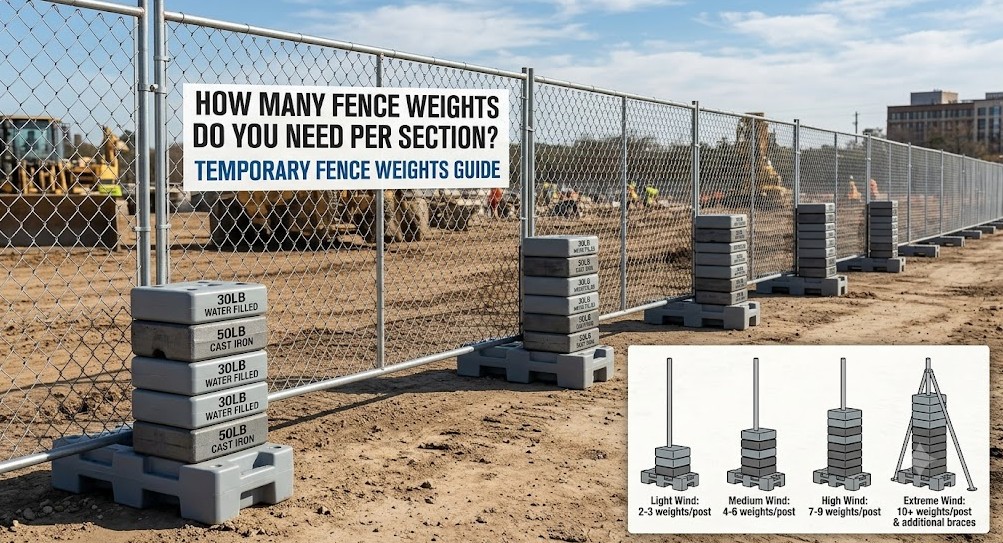
Temporary fencing needs to remain stable against wind, movement, uneven ground, and everyday job-site activity. One of the most common questions contractors and event organizers ask is: how many fence weights do you need per section?
The answer is not always as simple as one weight per panel. The correct number depends on the fence dimensions, construction, wind exposure, surface, privacy screening, and the manufacturer’s installation requirements. Choosing the right weight type is equally important, especially for projects where temporary fencing is installed and moved repeatedly.
How Many Fence Weights Do You Need Per Section? — Short Answer
There is no universal number of fence weights required for every temporary fence section. The appropriate quantity depends on panel size, height, material, wind exposure, ground conditions, privacy screens, and the manufacturer’s specifications. A reusable option such as The Stand Box TX can provide consistent 30-lb weighting for suitable temporary fencing applications, but the required number of units must be determined based on the specific fence system and conditions.
The key distinction is between weight quantity and weight adequacy. Simply placing one weight beside every panel does not guarantee sufficient stabilization.
What Determines How Many Fence Weights You Need Per Section?
Fence panel size and dimensions
A wider or taller fence panel generally presents more surface area to wind. A standard chain-link panel can behave differently from a large solid privacy panel.
Consider:
- Panel width
- Panel height
- Overall fence length
- Frame design
- Center of gravity
Larger panels may require a different stabilization approach than smaller sections.
Fence material and construction
Temporary fencing can include chain-link panels, mesh systems, metal panels, and solid privacy fencing. Open mesh allows some air to pass through, while solid materials can catch substantially more wind.
This distinction becomes especially important on exposed construction sites and outdoor events.
Wind exposure and weather conditions
A fence installed beside a building may have different requirements from one positioned in an open parking lot.
Consider:
- Open fields
- Construction sites
- Parking lots
- Roadside areas
- Coastal or exposed locations
- Forecast wind and gusts
Privacy screening, banners, and tarps can further increase wind exposure.
Ground and surface conditions
The surface underneath the fence affects stability and the available anchoring methods.
Common surfaces include:
- Concrete
- Asphalt
- Gravel
- Dirt
- Grass
An uneven surface can also affect how securely a base sits against the ground.
Manufacturer requirements
The manufacturer’s instructions should take priority over generic recommendations found online. Check the fence system’s approved base type, weight requirements, connection method, and installation configuration before determining how many weights are necessary.
How Many Fence Weights Do You Need Per Section? — Understanding the Basics
Why one fence weight may not always be enough
A one-weight-per-panel rule ignores factors such as wind, panel dimensions, privacy screening, and ground conditions.
A fence exposed to strong gusts may experience substantially different forces from one installed in a protected area.
Why weight distribution matters
Stabilization should be distributed across the fence line rather than concentrated in one location.
Proper distribution can help reduce:
- Panel tipping
- Fence movement
- Base shifting
- Weak points in the fence line
How connected fence panels affect stability
Connected panels work as a system, but that does not mean every section experiences identical forces.
Pay particular attention to:
- Corners
- End sections
- Gates
- Changes in fence direction
Why corners and end sections may require special consideration
Corners and exposed ends can experience different wind forces because they are not surrounded by panels in the same way as interior sections.
Gate sections can also move independently and may require specific stabilization according to the fence manufacturer’s instructions.
Types of Fence Weights and Bases
Concrete fence bases
Concrete bases offer substantial weight and durability, but transportation and handling can be difficult. They are often better suited to applications where the fence will remain in place for longer periods.
Water-filled fence bases
Water bases are relatively convenient to transport when empty. However, they require filling and draining and can present leakage or freezing considerations.
Sandbags
Sandbags are inexpensive and widely available, making them popular for temporary applications. However, repeated handling can cause tearing, leakage, moisture damage, and loss of fill material.
Steel or metal bases
Metal bases can provide a durable purpose-built option. Their suitability depends on the fence system, base design, weight, and required anchoring method.
Reusable purpose-built fence weights
Reusable weights offer consistent weight and can simplify storage and deployment. They are particularly useful for contractors and event operators who repeatedly install temporary equipment.
The Stand Box TX as a reusable fence-weight option
The Stand Box TX provides a 30-lb solid recycled-rubber weighting option designed for repeated use. Unlike sandbags, it does not require sand or another loose fill material.
Its molded handle can simplify handling, while its stackable design can make storage more convenient between projects.
For contractors managing temporary fencing across multiple job sites, reusable weights can also create a more standardized equipment inventory.
How Fence Weight Requirements Change by Application
Construction-site temporary fencing
Construction fencing may need stabilization while protecting equipment, defining work areas, or controlling access. Frequent repositioning also makes handling and durability important considerations.
Event fencing
Event fencing is commonly installed and removed repeatedly. Reusable weights can be particularly convenient for event companies, vendors, and organizers managing multiple setups.
Privacy fencing and screening
Privacy screens deserve special attention because they can significantly increase the amount of surface exposed to wind. A fence configuration that works without screening may require a different stabilization approach once screening is installed.
Temporary pedestrian barriers
Barriers around pedestrian areas need to remain stable despite routine movement and contact. The appropriate base should match the specific barrier system.
Fence lines around exposed areas
Open fields, parking lots, roadsides, and other exposed locations can experience stronger wind conditions than sheltered sites. Weather monitoring should be part of the installation plan.
Fence Weights Per Section: Comparison Table
| Weighting Option | Typical Characteristics | Reusable | Handling | Wind Considerations | Best For |
|---|---|---|---|---|---|
| Sandbags | Loose-fill, flexible | Depends on condition | Moderate | Can shift or deteriorate | Short-term use |
| Water bases | Fillable, lightweight empty | Yes | Easy when empty | Can leak/freeze | Events |
| Concrete bases | Heavy and durable | Yes | Difficult | Application-dependent | Longer-term use |
| Metal bases | Durable, purpose-built | Yes | Moderate | Depends on design | Temporary fencing |
| The Stand Box TX | Solid recycled rubber | Yes | Designed for handling | Application-specific | Repeated temporary use |
Why weight type matters as much as weight quantity
Two weights with the same nominal weight can perform differently because shape, contact area, center of gravity, attachment method, and fence compatibility all influence stability.
The goal is not simply to use the heaviest object available. It is to use an appropriate weighting system correctly.
How to Calculate the Number of Fence Weights You Need
Step 1: Count the total fence sections
Determine the number of individual panels, then identify corners, gates, and end sections separately.
Step 2: Identify the panel dimensions
Record the width, height, material, and any attached accessories.
Step 3: Evaluate wind exposure
Determine whether the fence is sheltered or exposed and consider expected wind and gusts.
Step 4: Check for privacy screens or banners
Additional wind-catching surfaces can change the stabilization requirements.
Step 5: Check the manufacturer’s requirements
Identify the approved base type, weight requirement, and installation configuration.
Step 6: Determine weight per section
Use the manufacturer’s specifications rather than relying on a generic online formula.
Step 7: Calculate the total inventory
A basic planning formula is:
Number of sections × required weights per section = total weights required
Calculate unusual sections separately where necessary.
Step 8: Keep contingency inventory
Extra weights can be useful for damaged units, fence reconfiguration, additional panels, or changing site conditions.
How to Use The Stand Box TX for Temporary Fence Stabilization
Positioning The Stand Box around fence sections
The weight should be positioned at the intended stabilization point rather than randomly along the fence line. Always follow the fence system’s installation instructions.
Determining how many Stand Box weights are needed
The Stand Box TX weighs 30 pounds per unit, but that does not mean one unit is automatically appropriate for every fence section.
The required number should be determined from the fence manufacturer’s requirements, panel configuration, wind exposure, and installation conditions.
Why reusable weights can simplify fence installation
The Stand Box TX eliminates several tasks associated with loose-fill weights:
- No filling
- No emptying
- No loose sand
- Consistent weight
- Easier storage
- Repeated deployment
Why The Stand Box TX can be valuable for contractors
A reusable inventory can move from project to project rather than requiring contractors to repeatedly purchase and dispose of consumable weighting materials.
That can make lifecycle costs, transportation, storage, and job-site logistics easier to manage.
How Wind Changes Temporary Fence Weight Requirements
Why temporary fences act like sails
Wind can create lateral pressure against fencing. Solid panels and privacy screens generally catch more wind than open mesh.
Why privacy screens need special attention
Adding a privacy screen changes the effective surface area exposed to wind. Contractors should reassess stabilization rather than assuming the original configuration remains adequate.
Why corners and exposed ends are vulnerable
Corners and end panels can experience different forces because of their position and exposure.
Why weather monitoring matters
Wind conditions can change during a project. Contractors should monitor forecasts and inspect temporary fencing after significant weather events.
Step-by-Step Guide: How to Determine Fence Weights Per Section
- Identify the fence system — Record the manufacturer, panel type, dimensions, and base style.
- Count every section — Include standard panels, gates, corners, and end sections.
- Evaluate the environment — Consider wind, surface, weather, and deployment duration.
- Identify wind-catching materials — Check for privacy screens, banners, tarps, or signs.
- Review manufacturer guidance — Confirm required weights and approved installation methods.
- Select the appropriate weight type — Compare sandbags, concrete, water, metal, and reusable weights.
- Distribute weights correctly — Support the fence according to the manufacturer’s configuration.
- Inspect the fence line — Check bases, connectors, alignment, and movement.
- Reassess after severe weather — Inspect and adjust the installation when conditions change.
Common Mistakes When Choosing Fence Weights
Assuming every fence section needs the same number of weights
Panel dimensions and environmental conditions can vary throughout a project.
Choosing weights based only on price
The cheapest initial option may become more expensive when replacement, labor, transportation, and cleanup are included.
Ignoring privacy screens
Privacy screening can substantially increase wind exposure.
Underestimating corner and gate requirements
Corners, gates, and exposed ends may require special consideration.
Using damaged sandbags
Tears, leakage, moisture, and lost fill can reduce the effectiveness and usability of deteriorated sandbags.
Placing weights incorrectly
A heavy weight cannot provide effective stabilization if it is positioned where it does not properly support the fence.
Failing to inspect after high winds
Check for shifted bases, loose connections, movement, and damaged components after significant weather.
Sandbags vs. The Stand Box TX for Temporary Fence Weights
Sandbags for temporary fencing
Sandbags can be a practical low-cost solution for occasional use, particularly when sand is already available. Their disadvantages become more apparent with frequent handling and outdoor exposure.
The Stand Box TX for temporary fencing
The Stand Box TX offers a reusable 30-lb solid recycled-rubber design without loose fill. Its molded handle and stackable form are suited to repeated handling and storage.
Which option makes more sense for frequent fence installations?
For occasional temporary fencing, sandbags may be sufficient when appropriate for the application. For contractors repeatedly moving fencing between projects, reusable weights can provide greater operational convenience.
Consider:
- Cost per deployment
- Labor
- Storage
- Transportation
- Replacement frequency
- Reusability
Why reusable weights can be a better long-term inventory strategy
Instead of repeatedly sourcing, filling, replacing, and disposing of temporary weighting materials, contractors can maintain a standardized inventory of reusable weights.
That makes solutions such as The Stand Box TX particularly relevant for businesses with recurring temporary stabilization needs.
How Many Fence Weights Do You Need Per Section? — Practical Examples
Example 1: Standard temporary fence with no privacy screen
Start with the fence manufacturer’s specified base and weight requirements. Then multiply the required support by the number of standard panels.
Example 2: Temporary fence with privacy screening
Do not automatically use the same configuration. Screening increases wind-catching surface and may change the manufacturer’s stabilization requirements.
Example 3: Fence around an exposed construction site
Consider open terrain, wind gusts, fence height, and the duration of deployment. A reusable weight inventory can also be useful when sections are frequently relocated.
Example 4: Event fencing on asphalt
Since staking may not be practical, a suitable surface-compatible weighting system becomes particularly important. Reusable weights can simplify repeated event setup and teardown.
Example 5: Long temporary fence line with multiple corners
Calculate standard panels separately from corners, gates, and end sections. Do not assume every section has identical stabilization requirements.
Frequently Asked Questions About Fence Weights
How many fence weights do you need per section?
There is no universal number. The correct quantity depends on the fence system, panel dimensions, wind exposure, surface, privacy screening, and manufacturer requirements.
Do all temporary fence panels require weights?
Not necessarily. Some systems use different anchoring methods or base configurations. Always follow the specific manufacturer’s installation instructions.
How much does a temporary fence weight need to weigh?
Weight requirements depend on the fence design and environmental conditions. The nominal weight alone does not determine whether a base is adequate.
Are sandbags good for temporary fence weights?
Sandbags can work for appropriate short-term applications, but they can experience tearing, moisture exposure, leakage, and fill loss with repeated outdoor use.
Are reusable fence weights better than sandbags?
For frequent users, reusable weights can provide advantages in handling, storage, consistency, and lifecycle value. The best choice depends on the project and fence system.
Can The Stand Box TX be used for temporary fencing?
The Stand Box TX is a reusable 30-lb weighting product suitable for certain temporary stabilization applications. Compatibility and required quantity should be confirmed against the specific fence manufacturer’s requirements.
How many 30-lb weights do I need for a fence panel?
You cannot safely determine the number from the 30-lb figure alone. Panel size, construction, wind exposure, surface, and manufacturer specifications all need to be considered.
Do privacy screens require more fence weights?
They may. Privacy screens increase the surface exposed to wind, so the fence manufacturer’s requirements should be reassessed when screening is installed.
Do fence corners need additional weight?
Corners and exposed ends can experience different forces from interior panels. Follow the fence system’s recommended stabilization configuration.
What is the best reusable fence weight for construction sites?
The best option depends on the fence system and conditions. The Stand Box TX is one reusable option for suitable applications, offering a solid 30-lb recycled-rubber design without loose fill.
How Many Fence Weights Do You Need Per Section? — Final Answer
So, how many fence weights do you need per section? There is no single number that applies to every temporary fence.
The correct quantity depends on panel dimensions, fence construction, wind exposure, ground surface, privacy screening, corners and gates, and manufacturer specifications. Weight distribution is also important because total weight alone does not guarantee effective stabilization.
Contractors should avoid relying on generic formulas when manufacturer-specific requirements are available. Instead, evaluate the complete fence system and environmental conditions before selecting the appropriate number and type of weights.
For businesses that repeatedly install temporary fencing, The Stand Box TX provides a reusable 30-lb solid recycled-rubber weighting option that can simplify handling, storage, and repeated deployment.
The most important rule is simple: choose the weight based on the fence system and conditions, not simply on how many weights fit beside each panel.