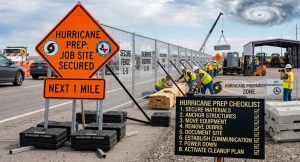

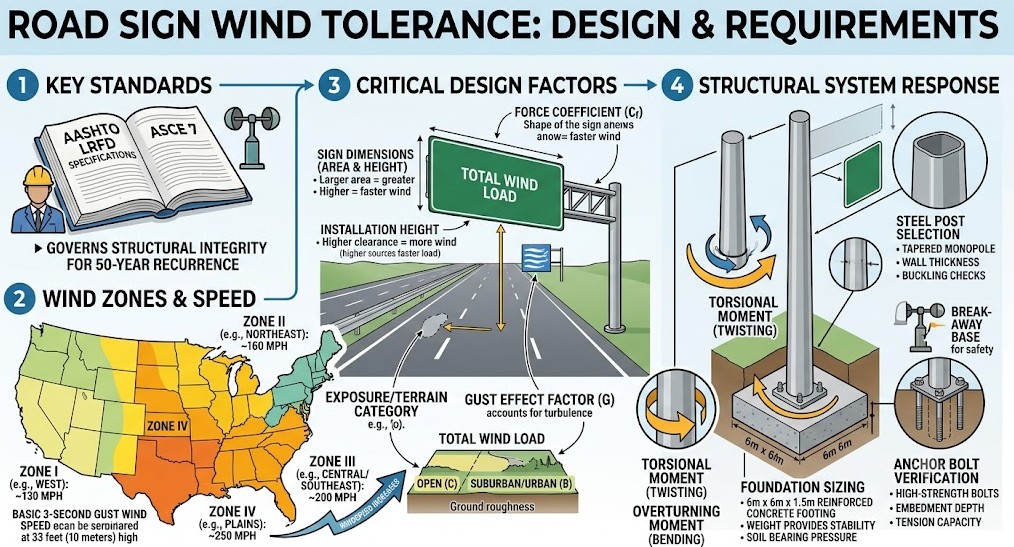
A road sign may look simple, but keeping it upright in windy conditions involves more than choosing a heavy base. Wind pushes against the sign surface, creating a force that can cause the sign to tip, slide, rotate, or shift from its intended position.
So, how much does a road sign need to stay up in wind? There is no single weight that works for every road sign. The required stability depends on the sign’s size, height, wind exposure, mounting system, base footprint, ground conditions, and whether the installation is temporary or permanent.
For temporary construction signs and traffic control signs, the goal is to create a stable installation that can withstand expected conditions without making setup, relocation, and removal unnecessarily difficult.
How Much Does a Road Sign Need to Stay Up in Wind? — Short Answer
There is no universal ballast weight for a road sign. A small sign in a sheltered location may require considerably less stabilization than a large sign mounted high above the ground in an exposed work zone.
The most important factors are:
- Sign dimensions and exposed surface area
- Expected wind speed and gusts
- Sign height and mounting configuration
- Base footprint and geometry
- Ground surface and slope
- Weight distribution and center of gravity
- Sign orientation
- Temporary versus permanent installation
It is also important to distinguish between preventing tipping and preventing sliding. A base can be heavy enough to resist one type of movement but still allow another.
What Makes a Road Sign Stay Up in Wind?
How Much Does a Road Sign Need to Stay Up in Wind?
Wind creates pressure against the exposed face of a sign. That pressure produces a force, and the force acts at a height above the ground. The higher that force acts, the greater the overturning effect can become.
The base counters this force through its weight, footprint, and contact with the ground. This is why simply adding more weight is not always the complete answer. A well-designed base can improve stability by keeping the center of gravity low and distributing weight effectively.
Wind Load and Wind Speed
Wind force increases rapidly as wind speed increases. A sign that remains stable during ordinary conditions may behave very differently during strong gusts.
For this reason, temporary sign stabilization should consider expected wind gusts, not simply average wind conditions. Locations with open exposure can experience substantially greater wind loading than sheltered areas.
Sign Size and Surface Area
A larger sign presents more surface area to the wind. This means two signs using identical ballast may not have identical stability.
A small portable sign may be relatively easy to stabilize, while a large panel mounted on tall supports can create significantly greater wind forces.
Sign Height and Center of Gravity
Mounting height also matters. A taller sign gives wind force greater leverage against the base.
Keeping the center of gravity as low as practical helps improve resistance to overturning. This is one reason base design is just as important as total ballast weight.
Sign Orientation and Wind Exposure
A flat sign facing directly into the wind can experience substantial pressure. Surrounding buildings, trees, vehicles, and structures may change local wind conditions, but these should not automatically be treated as reliable protection.
Site-specific exposure should always be considered when selecting stabilization.
How Much Weight Does a Temporary Road Sign Need?
Portable Road Signs
Portable signs need to balance stability with mobility. The base must provide enough resistance to movement without making the sign impractical for crews to transport and install.
Temporary Construction Signs
Construction sites often experience changing ground conditions, open exposure, equipment movement, and frequent sign relocation. A reusable stabilization system can be more practical than disposable ballast when signs must be deployed repeatedly.
Traffic Control Signs
Traffic-control signs require particular attention because an unstable sign can move into an area used by vehicles, workers, or pedestrians. The appropriate stabilization method depends on the complete sign configuration and applicable requirements. For temporary traffic-control applications, The Stand Box provides reusable weight solutions designed to help stabilize signs, barricades, and other temporary equipment without relying solely on traditional sandbags. Its durable, reusable design can be particularly useful for construction sites and other applications where temporary traffic-control equipment needs to be deployed, relocated, and secured repeatedly.
Large Road Signs vs. Small Road Signs
Large signs generally require greater consideration of wind loading because they expose more surface area and may be mounted higher. Smaller signs can still become unstable when exposed to strong winds, particularly when their bases are narrow or poorly positioned.
What Type of Base Is Best for Keeping a Road Sign Stable in Wind?
Sandbags
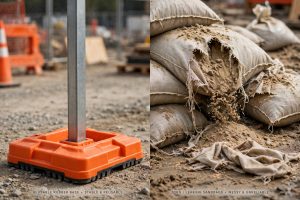
Sandbags are widely used as temporary ballast because they are inexpensive and easy to deploy. However, they can tear, shift, absorb moisture, and become difficult to handle after repeated use.
Water-Filled Bases
Water-filled bases provide portable ballast and can be relatively easy to transport when empty. However, they require access to water and can present practical challenges in freezing conditions or during long-term outdoor use.
Reusable Solid Weights
Purpose-built reusable weights provide consistent ballast without relying on loose material. They can be designed for repeated handling, transportation, and deployment, making them useful for construction, traffic control, and other temporary outdoor applications.
Built-In or Permanent Foundations
Permanent foundations are appropriate when a sign is intended to remain installed for an extended period and engineering requirements call for a fixed installation. They are fundamentally different from portable temporary stabilization systems.
How to Calculate the Weight Needed to Keep a Road Sign Up in Wind
There is no reliable single-number calculation based only on sign weight. A basic evaluation should consider the complete installation.
Step 1: Determine the Sign’s Size and Surface Area
Measure the sign’s width and height to determine how much surface is exposed to wind.
Step 2: Determine the Expected Wind Conditions
Identify expected wind speeds, local exposure, and potential gust conditions. For critical installations, use appropriate engineering or regulatory guidance rather than relying on a general estimate.
Step 3: Evaluate Sign Height and Mounting Position
Measure how high the sign sits above the ground. A higher mounting position can increase the leverage produced by wind.
Step 4: Evaluate the Base and Its Footprint
Consider base dimensions, ground contact, weight distribution, and center of gravity. A wide, stable footprint can improve resistance to tipping.
Step 5: Determine the Required Ballast
Ballast should be selected for the entire sign-and-base configuration. Manufacturer specifications and applicable engineering requirements should take priority over arbitrary weight recommendations.
Step 6: Inspect the Installation Before and During Use
Check connections, ballast placement, ground contact, tilting, movement, and signs of deterioration. Reinspect after significant weather events.
Road Sign Wind Stability: Weight vs. Base Design
| Stability Factor | Lower Stability | Higher Stability |
|---|---|---|
| Sign size | Large exposure | Appropriate configuration |
| Wind exposure | Fully exposed | Lower exposure |
| Mounting height | High | Lower center of gravity |
| Base footprint | Narrow | Wide |
| Center of gravity | High | Low |
| Ballast | Insufficient | Adequate for conditions |
| Ground condition | Soft/uneven | Firm/level |
| Weight distribution | Concentrated poorly | Evenly distributed |
The heaviest possible base is not necessarily the best solution. Weight, geometry, footprint, and ground contact work together.
How Different Road Sign Stabilization Methods Compare
| Method | Wind Stability | Portability | Reusability | Durability | Best Use |
| Sandbags | Moderate | Moderate | Low–Moderate | Low–Moderate | Short-term setups |
| Water-filled bases | Moderate–High | Moderate | High | Moderate | Portable signs |
| Solid reusable weights | High | High | High | High | Repeated deployments |
| Permanent foundation | Very High | Low | N/A | Very High | Permanent installations |
Actual performance varies according to sign dimensions, wind conditions, installation method, and manufacturer specifications.
What Happens If a Road Sign Is Not Heavy Enough for Wind?
The Sign Can Tip Over
Wind can generate an overturning force that exceeds the stabilizing capacity of the base, particularly with tall signs.
The Sign Can Slide or Shift
Sliding is different from tipping. A sign may remain upright while moving across the ground if friction and ballast are insufficient.
The Sign Can Damage Other Equipment
A displaced sign can strike barriers, fencing, vehicles, equipment, or nearby structures.
The Sign Can Become a Safety Hazard
Movement is particularly concerning around active traffic-control areas and construction zones, where workers and vehicles may be nearby.
How to Keep a Road Sign From Blowing Over
Use Adequate Ballast
Select ballast based on the complete sign configuration and expected conditions.
Use a Stable, Wide Base
A suitable footprint can improve resistance to tipping and movement.
Keep the Installation on Firm Ground
Whenever practical, position the base on stable, level ground with reliable contact.
Position the Sign Correctly
Consider wind exposure, orientation, surrounding structures, and the intended operating environment.
Inspect Signs After Strong Winds
Look for tilting, movement, damaged connections, shifted ballast, or changes in ground contact.
Road Sign Wind Stability for Construction and Traffic-Control Applications
Temporary Construction Zones
Construction signs are frequently relocated and exposed to changing weather. Durable, reusable stabilization can simplify repeated installation.
Work Zones and Traffic Control
Preventing signs from shifting into vehicle or pedestrian paths is an important part of maintaining a controlled work environment.
Events, Parking Areas, and Temporary Outdoor Installations
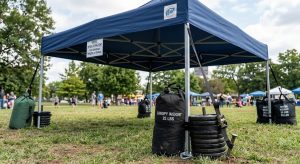
The same principles apply to temporary signs used around events and parking areas. Portable stabilization should provide an appropriate combination of stability, durability, and ease of deployment.
Frequently Asked Questions About Road Signs and Wind
How much does a road sign need to stay up in wind?
There is no universal weight. Required stabilization depends on sign size, height, wind speed, exposure, base design, and ground conditions.
How much weight does a temporary road sign need?
The required ballast varies by sign configuration and expected wind conditions. Manufacturer specifications or engineering guidance should be used where applicable.
What wind speed can knock over a road sign?
There is no single wind-speed threshold. Different sign sizes, heights, shapes, bases, and ground surfaces respond differently to wind.
How do you stop a temporary road sign from blowing over?
Use appropriate ballast, a stable base footprint, firm ground, suitable positioning, and regular inspections.
Are sandbags enough to hold down a road sign?
They can provide temporary ballast, but their effectiveness depends on the complete installation and conditions. They can also shift, tear, and deteriorate with repeated outdoor use.
Are heavier road sign bases always better?
No. Stability depends on more than weight. Base footprint, geometry, center of gravity, and ground contact also matter.
What is the best base for a temporary road sign in high winds?
There is no universally best base. Sandbags, water-filled bases, reusable solid weights, and permanent systems each suit different applications.
How do you calculate wind load on a road sign?
Wind-load evaluation considers factors such as wind speed, exposed area, sign geometry, height, and installation conditions. Critical installations should use appropriate engineering calculations rather than a generic online estimate.
Conclusion: Choosing the Right Weight for Road Sign Wind Stability
The answer to how much does a road sign need to stay up in wind cannot be reduced to one universal number. A stable installation depends on the relationship between the sign’s size, wind exposure, mounting height, base footprint, weight distribution, ground conditions, and installation type.
For temporary signs, the objective is not simply to use the heaviest possible ballast. The better approach is to use a stabilization system designed for the application, one that provides appropriate resistance to tipping and movement while remaining practical to transport, deploy, inspect, and reuse.
For construction sites, traffic-control areas, events, and other temporary outdoor applications, reusable solid weights can provide a more consistent alternative to disposable ballast when repeated deployment and dependable stabilization are priorities.