

Temporary fencing fails in a way that is hard to miss. A run of panels does not tip over one at a time. It goes down like dominoes, thirty or forty feet at once, usually overnight, and the crew finds it in the morning lying across a sidewalk or a neighboring property. The reason it fails as a run rather than as individual panels is the same reason it is harder to secure than most people expect, and it is worth working through before reaching for more weight.
The instinct is to think of a fence as a series of panels, each standing on its own feet. In wind, it does not behave that way at all.
The panels are clamped together at the uprights, so a run of ten panels is mechanically a single structure a hundred and twenty feet long. When wind loads that structure, the force does not stay where it lands. It travels along the run, through the clamps, and concentrates at the points that are least able to resist it. That is why the failure is never one panel. One point in the run gives, that section leans, and its load transfers to its neighbors, which are now carrying more than they were designed for. They give in turn, and the whole run goes.
The practical consequence is that securing a fence means securing the weakest point in the run, not the average point. Nine well-weighted panels and one bare foot gives you a fence held up by the bare foot.
Bare chain link is mostly holes, and wind passes through it. The panels catch some load at the uprights and the rails, but an open mesh fence in an open lot is not under enormous pressure, and crews get away with light anchoring for exactly that reason.
Then somebody adds privacy screen, windscreen, or debris netting, and the entire situation changes. A panel that was mostly open is now a solid surface, and it catches wind the way a sail does. The load on that same fence goes up dramatically, and it does so on a fence that was anchored for the open version.
This is the single most common cause of a fence run going down, and it is almost always a surprise to whoever put the screen up. The screen went on for privacy, or to keep dust in, or because the client asked, and nobody revisited the anchoring afterward. If you are adding screen to a run, you are building a different fence and it needs to be weighted like one. Some manufacturers publish guidance on the wind load their panels and screens are rated for, and that guidance is worth reading rather than guessing.
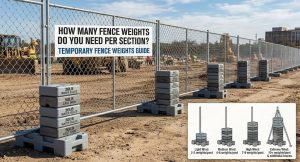
Most temporary fence panels sit in a base, either a plastic or concrete block foot with holes for the uprights, or a stand that the panel drops into. That foot is doing two separate jobs, and it usually only does one of them well.
The first job is holding the panel upright, which the foot handles fine as long as nothing is pushing on it. The second job is resisting the panel being pushed over, and that is a question of how much weight is sitting on that foot and how far the foot extends from the panel. A foot on its own is generally not enough for a run in any meaningful wind, which is why crews add weight to them, and why the way that weight sits on the foot matters as much as how much of it there is.
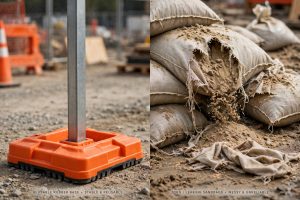
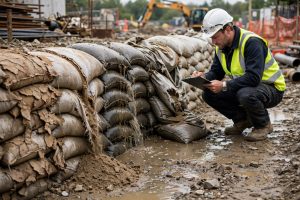
A sandbag draped over a fence foot is doing very little. The bag rests on the foot rather than gripping it, and as the sand settles the bag slumps and works its way off center until it is sitting beside the foot on the ground. At that point the panel can lift and the bag stays exactly where it is. The bag can be full and intact and still contribute nothing at the moment the wind actually arrives.
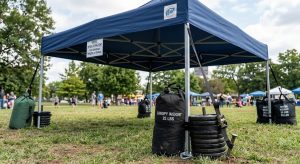
Weight that grips the foot behaves differently. The Stand Box is molded with dual channels in the base that fit over the feet of temporary fencing and road signs, so the unit drops onto the foot and locks to it. When the panel takes a load, the weight and the foot move as one piece, which is to say they do not move. That mechanical connection is what a bag cannot replicate, and on a fence run, where the load transfers along the whole structure looking for a weak point, it is the difference between a run that holds and a run that finds one loose foot and unzips from there.
Weight alone is a blunt solution, and past a certain point adding more of it stops helping. A fence panel is tall and narrow, which means wind pushing on the face has a great deal of leverage against a foot that is only a couple of feet wide. Bracing widens that base. A brace panel set at a right angle to the run, or a stay running from the top of the upright back to a weighted foot on the ground, changes the geometry so the wind has to lift a much wider footprint to tip anything over.
The rule of thumb crews use is to brace at the ends of a run, at corners, at gates, and at intervals through any long straight section. Ends and corners matter most because that is where the run has nothing on one side to help carry the load. A long straight run with braced ends is far more stable than the same run with weight spread evenly and no bracing at all, and it usually costs less.
Braces need weight on their feet too, and that weight needs to grip the same way the rest of it does. A brace with a loose sandbag on it is a brace that lifts.
Every discontinuity in a run is a place where the load stops transferring and has to be resisted locally. Gates are the worst of these. A gate panel swings, which means it is not clamped into the run the way everything else is, and it catches wind on both faces depending on the day. A gate left open in wind is a large lever attached to a post that was never asked to handle it. Gates need weight, they need bracing, and they need to be latched shut when nobody is using them.
Corners are the second problem. A corner takes load from two directions and has half the neighboring structure to help. Weight and brace both legs of every corner rather than treating it as an ordinary point in the run.
The ends of a run are the third. An unbraced end panel has nothing beyond it and will lift first, and once it does the run has an open edge for the wind to work into.
The site itself sets the ceiling on how well any of this works.
Soft ground lets feet sink unevenly, which puts panels out of plumb and loads one upright more than the other. Slopes mean the panels are not sitting square and the weight on each foot is not doing what you assume. Loose gravel lets feet skate sideways under load rather than resisting it. Wet ground turns to mud and everything moves.
Where the ground allows staking, stake it. Stakes through the feet into solid dirt outperform any amount of surface weight, and the reason crews use ballast in the first place is usually that the site is asphalt, concrete, or a finished surface where staking is not permitted. If you are on ground that can take a stake, the fence should be staked and weighted, not one or the other.
Put together, securing a run comes down to a short sequence. Weight every foot rather than every third one, because the run finds the weakest point and fails there. Use weight that grips the foot instead of resting near it, so the connection survives the moment the panel actually lifts. Brace the ends, the corners, and the gates, and weight the brace feet the same way. Check what the panels are wearing, because screen and netting change the wind load completely and the anchoring has to change with it. Look at the ground and stake it if the site allows.
Then walk the run before weather arrives and look for the foot somebody skipped, because there is always one, and it is the one that decides how the night goes.
Temporary fencing goes down as a run because it is a run, mechanically joined from end to end and failing at whichever point is weakest. Weight on every foot, weight that locks to the foot instead of leaning on it, bracing at the ends and corners and gates, and honest attention to what the panels are carrying will keep a run standing through the wind it was going to see anyway.
The fence that ends up on the sidewalk overnight almost never went down because the wind was extraordinary. It went down because one foot in a hundred and twenty feet of fence had a sandbag on it that had slid off six weeks earlier and nobody looked.