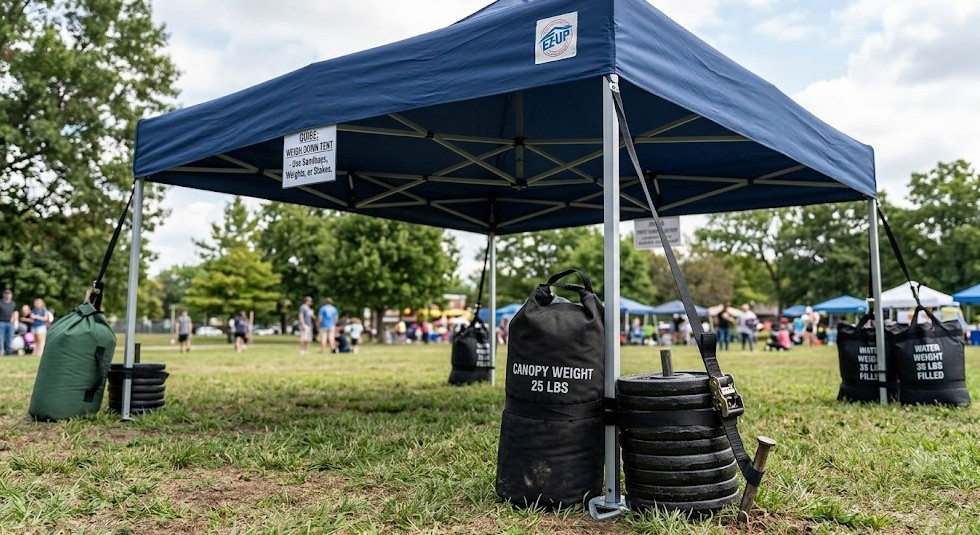
An EZ-Up tent or pop-up canopy can become unstable quickly when wind picks up. Because the large canopy roof catches moving air, an unsecured structure can slide, tip, lift, or potentially become airborne. Proper weighting is therefore not just about making the tent heavier, it is about distributing adequate stabilization across the structure and knowing when conditions have exceeded the canopy’s safe operating limits.
For event organizers, vendors, contractors, and outdoor businesses, choosing the right EZ-Up tent weights can make setup more practical and repeatable. Traditional sandbags remain common, but reusable options such as The Stand Box TX provide another approach for users who regularly need temporary weights.
How to Weigh Down an EZ-Up Tent or Canopy in High Wind? — Short Answer
The best way to weigh down an EZ-Up tent in windy conditions is to use manufacturer-approved anchoring with adequate weight at the canopy legs, adjusted for the canopy size, surface, configuration, and expected wind. Do not rely on household objects or undersized weights. The Stand Box TX offers a reusable 30-lb solid recycled-rubber weighting option, but no weight can make a temporary canopy safe beyond its rated conditions.
The objective is to prevent the canopy from sliding, tipping, lifting, or becoming airborne. If severe weather develops, taking the canopy down may be safer than simply adding more weight.
How Much Weight Does an EZ-Up Tent Need in High Wind?
There is no universal weight requirement that applies to every EZ-Up or pop-up canopy.
Why there is no single weight recommendation for every canopy
The appropriate anchoring method can depend on:
- Canopy dimensions
- Height
- Leg configuration
- Ground surface
- Wind exposure
- Sidewalls
- Banners or displays
- Manufacturer specifications
A 10×10 canopy in a sheltered location may experience very different forces from a 10×20 canopy positioned in an open parking lot.
How wind affects a pop-up canopy
Wind can push against the canopy roof and enter underneath it. Sidewalls, banners, and other accessories can increase the amount of surface area exposed to moving air.
As wind increases, a canopy can experience several different problems:
- Sliding across the surface
- Tilting or tipping around a leg
- Lifting as wind gets underneath the canopy
Properly distributed weights help stabilize the legs, but they do not eliminate aerodynamic forces.
Why adding more weight is not always enough
A common mistake is assuming that enough weight can make any canopy safe in any wind.
Temporary canopies have operating limitations. When conditions exceed the manufacturer’s recommendations, the appropriate response may be to remove the canopy rather than continue adding weights.
What Is the Best Way to Weigh Down an EZ-Up Tent?
Several types of pop-up canopy weights can be used, depending on the application.
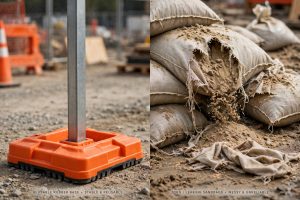
Sandbags
Sandbags are one of the most familiar canopy anchoring methods.
Advantages:
- Widely available
- Relatively inexpensive
- Easy to fill in many locations
Limitations:
- Require loose fill
- Can tear or leak
- Sand can spill
- Bags can become wet and dirty
- Repeated handling can cause wear
They can be practical for occasional, short-term use, but their limitations become more noticeable when they are repeatedly transported and deployed.
Water weights
Water-filled weights are another option.
They are often easier to transport while empty, but users must account for:
- Filling and draining
- Potential leaks
- Freezing temperatures
- Storage
- Stability on different surfaces
Concrete blocks
Concrete blocks provide substantial weight and can be inexpensive, but they are cumbersome.
They can be difficult to transport, awkward to position, and potentially damaging if they strike the canopy frame or other equipment.
Purpose-built canopy weights
Purpose-built weights are designed specifically for temporary structures and repeated deployment.
They can offer:
- Consistent weight
- Easier handling
- Reusability
- Simplified storage
- Less dependence on loose fill
The Stand Box TX as a reusable weighting option
The Stand Box TX takes the purpose-built approach. Its 30-lb weight is made from solid recycled rubber and is designed for repeated use without sand or another loose fill material.
The product features a molded handle and stackable design, making it particularly relevant for contractors, event companies, vendors, and other organizations that regularly transport and store temporary weights.
Multiple units may be used when additional weight is required, but the correct quantity should always be determined according to the canopy manufacturer’s anchoring requirements and actual conditions.
How to Weigh Down an EZ-Up Tent or Canopy in High Wind? — Key Factors
Canopy size
A 10×10 canopy, 10×20 canopy, and larger temporary structure should not automatically be treated as having identical anchoring requirements.
Larger canopies generally present more surface area to the wind, making proper stabilization increasingly important.
Ground surface
Consider whether the canopy is being installed on:
- Grass
- Asphalt
- Concrete
- Gravel
- Dirt
Stakes may work in some surfaces but not others. Where staking is unavailable or unsuitable, properly selected weights become especially important.
Canopy configuration
An open canopy does not interact with wind in exactly the same way as one equipped with sidewalls.
Also consider:
- Banners
- Displays
- Connected canopies
- Hanging materials
- Other wind-catching accessories
Wind exposure
An open field, parking lot, beach, or large event area can expose a canopy to significantly more wind than a sheltered location.
Natural windbreaks can reduce exposure, but they should never replace proper anchoring.
Sandbags vs. The Stand Box vs. Other Canopy Weights
| Weighting Method | Reusable | Easy to Transport | Fill Required | Key Consideration | Best For |
|---|---|---|---|---|---|
| Sandbags | Depends on condition | Moderate | Yes | Can tear or leak | Short-term canopy use |
| Water weights | Yes | Easy when empty | Yes | Leakage/freezing considerations | Events and recreation |
| Concrete blocks | Yes | Difficult | No | Heavy and cumbersome | More stationary setups |
| The Stand Box TX | Yes | Designed for handling | No | Solid recycled-rubber construction | Repeated event and temporary use |
What makes The Stand Box different from a traditional sandbag?
The key difference is the construction.
A sandbag uses a flexible container to hold loose material. The Stand Box uses solid recycled rubber, eliminating the need to purchase, transport, fill, empty, or replace loose sand.
Its molded handle also provides a dedicated point for handling, while its stackable design can simplify storage between events or projects.
It should be viewed as a reusable weighting alternative, not as a guarantee that a canopy is safe during severe weather.
Why Canopy Weights Matter More in High Wind
Preventing the canopy from sliding
Weight increases the force holding the canopy against the ground. This can help reduce movement, particularly on smoother surfaces.
However, the weight needs to be positioned correctly rather than simply placed somewhere underneath the canopy.
Reducing the risk of tipping
Stabilizing individual legs helps reduce the likelihood of the frame rotating or tipping around an unsecured point.
Balanced distribution is generally more effective than concentrating all available weight in one location.
Reducing the risk of the canopy lifting
Wind can get underneath a canopy and create upward forces. Proper anchoring helps resist movement, but the canopy’s design and operating limits still matter.
Weights should be attached using appropriate, manufacturer-approved methods.
Why uneven weighting can create problems
If one leg is unsecured while others are heavily weighted, the structure can still move around the weak point.
Uneven loading can contribute to:
- Canopy movement
- Frame stress
- Tilting
- Instability
Step-by-Step Guide: How to Weigh Down an EZ-Up Tent or Canopy in High Wind
Step 1: Check the canopy manufacturer’s wind guidance
Start with the manufacturer’s instructions. Determine the recommended anchoring method and any stated operating limitations.
Step 2: Check the weather and wind forecast
Check conditions before setup and continue monitoring them during the event.
Do not wait until the canopy is already moving before deciding what to do.
Step 3: Identify the ground surface
Determine whether you can safely use stakes and what type of weight is appropriate for the surface.
Step 4: Determine the required weight
Consider:
- Canopy dimensions
- Wind conditions
- Surface
- Sidewalls
- Accessories
- Manufacturer requirements
Step 5: Place appropriate weight at each leg
Distribute stabilization across the canopy rather than relying on one central weight.
Step 6: Secure the weights to the canopy frame
Use appropriate straps, attachment points, or manufacturer-approved systems. Avoid improvised connections that can damage the frame.
Step 7: Inspect every anchor point
Check the:
- Straps
- Connections
- Weights
- Canopy legs
- Frame
Look for movement before allowing the canopy to remain unattended.
Step 8: Monitor conditions throughout the event
Weather can change rapidly. Continue checking wind and watch for movement or instability.
Step 9: Remove the canopy when conditions become unsafe
Additional weight is not a substitute for removing a temporary structure when conditions exceed its safe operating limits.
People should always take priority over protecting the canopy or equipment.
How to Use The Stand Box TX to Weight Down Temporary Canopies
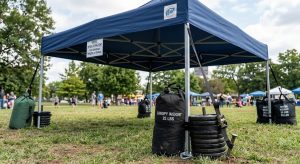
Positioning reusable weights around canopy legs
Place the weights at the appropriate canopy legs and attachment points according to the manufacturer’s instructions.
The objective is distributed stabilization rather than concentrating weight in one area.
Using multiple weights when additional weight is required
The Stand Box TX weighs 30 pounds per unit. That does not mean one unit is automatically sufficient for every canopy.
The number of units required should be determined by the canopy manufacturer’s specifications and the actual installation conditions.
Why solid rubber can be convenient for repeated events
A reusable solid weight can eliminate several tasks associated with sandbags:
- No loose sand
- No filling
- No emptying
- No spilled fill material
- Easier handling
- Repeated use
- Stackable storage
Where The Stand Box TX can fit beyond canopies
The Stand Box TX can also be relevant for temporary applications involving:
- Event tents
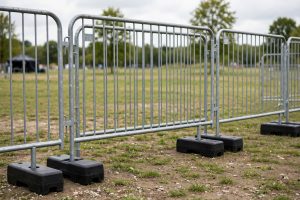
- Barricades
- Temporary signs
- Traffic-control equipment
- Temporary fencing
- Construction-site equipment
This broader application can make reusable weights more useful for companies that need stabilization equipment across multiple types of projects.
Common Mistakes When Securing an EZ-Up Tent in High Wind
Using too little weight
Undersized weights may not provide sufficient stabilization for the actual conditions.
Putting all the weight in one location
Concentrating weight at one point leaves other legs vulnerable to movement.
Ignoring sidewalls
Sidewalls can change how wind interacts with a canopy and should be considered during anchoring.
Using household objects as improvised anchors
Coolers, chairs, water containers, and other household objects are not necessarily designed or rated for canopy anchoring.
Forgetting to check the ground surface
Anchoring requirements can vary substantially between grass, asphalt, concrete, and other surfaces.
Leaving the canopy unattended during worsening weather
A canopy should be monitored whenever changing weather could affect its stability.
Assuming heavy weights eliminate all wind risk
Even substantial weights cannot override a temporary canopy’s operating limitations.
How to Make an EZ-Up Tent More Stable in Wind
Use all manufacturer-approved anchoring points and distribute weight evenly across the structure.
Other practical measures include:
- Keep the canopy properly tensioned.
- Minimize unnecessary wind-catching accessories.
- Remove sidewalls when appropriate and permitted.
- Position the canopy away from unnecessary wind exposure.
- Inspect the frame and legs before deployment.
- Keep a rapid teardown plan ready.
Good preparation is often more effective than trying to react after wind conditions have already deteriorated.
When Should You Take Down an EZ-Up Tent Because of Wind?
Watch for increasing wind speeds
Do not rely only on how the weather looks. Monitor actual forecasts and conditions.
Take action when the canopy begins moving
Warning signs include:
- Sliding
- Shaking
- Tilting
- Lifting
These are signs that the structure is experiencing forces that should not be ignored.
Follow manufacturer limits
Manufacturer guidance should take priority over generic online recommendations.
Evacuate when severe weather creates a hazard
Lightning, severe thunderstorms, tornado threats, extreme wind, and flying debris can create hazards that cannot be solved simply by adding weight.
Weighting a canopy is not a substitute for removing it when conditions exceed its safe operating limits.
When Are Sandbags Still a Good Choice for EZ-Up Canopies?
Sandbags remain practical for some applications.
They can make sense for short-term events, low-frequency canopy use, or situations where sand is already readily available.
The tradeoff is that repeated outdoor use can introduce additional handling, storage, moisture, leakage, and replacement concerns.
When Is The Stand Box TX a Better Choice for Canopy Weights?
Repeated event setups
Event companies, vendors, contractors, trade-show operators, and festival organizers may benefit from reusable weights when the same equipment is deployed repeatedly.
Businesses that transport weights between locations
A standardized reusable weight inventory can simplify transportation and storage while eliminating the need to source sand for every setup.
Applications where loose-fill sandbags create additional work
The Stand Box eliminates the need for filling and emptying sandbags and avoids spilled sand during normal handling.
Organizations looking for reusable event weights
The most important comparison is not always purchase price. Businesses should evaluate how frequently the weight will be deployed and what each use costs over its lifecycle.
Can You Use The Stand Box for Other Temporary Equipment?
Yes, its broader value comes from being a reusable weighting solution rather than a single-purpose canopy accessory.
Potential applications include:
Event tents and canopies
Temporary outdoor structures can require portable stabilization.
Barricades
Reusable weights can help stabilize temporary barriers where appropriate.
Temporary signs
Purpose-built weights can be used with suitable sign systems.
Traffic-control equipment
The Stand Box TX can fit into temporary traffic-control applications where the product and installation requirements are appropriate.
Temporary fencing
Weights can provide stabilization for certain temporary fencing systems.
Construction-site equipment
Contractors can potentially use the same reusable inventory across different temporary job-site applications.
Frequently Asked Questions About How to Weigh Down an EZ-Up Tent or Canopy in High Wind
How much weight do I need to hold down an EZ-Up tent in wind?
There is no universal number. The required weight depends on the canopy size, wind conditions, ground surface, sidewalls, configuration, and manufacturer specifications. Always follow the manufacturer’s anchoring requirements.
How do you keep an EZ-Up tent from blowing away?
Use manufacturer-approved anchoring, distribute adequate weight across the canopy legs, monitor weather conditions, and remove the canopy when conditions exceed its safe operating limits.
Are sandbags enough to hold down an EZ-Up canopy?
They may be adequate for some applications, but there is no universal answer. The canopy’s specifications, wind conditions, surface, and anchoring method all matter.
What is the best weight for an EZ-Up tent?
The best option depends on the application. Sandbags, water weights, concrete blocks, and purpose-built reusable weights all have advantages and limitations. For repeated deployments, reusable canopy weights can reduce filling, handling, and replacement work.
Can I use The Stand Box TX to weigh down an EZ-Up tent?
The Stand Box TX is a reusable 30-lb weighting product that can be used for suitable temporary-structure applications. However, users should determine the number of weights and attachment method according to the canopy manufacturer’s requirements and actual weather conditions.
How many weights do I need for a 10×10 canopy?
There is no safe universal number that applies to every 10×10 canopy. Check the specific canopy manufacturer’s requirements and account for the expected wind, surface, sidewalls, and accessories.
Should I use weights on every leg of an EZ-Up tent?
In general, stabilization should be distributed across the canopy rather than concentrated in one location. Follow the manufacturer’s recommended anchoring configuration for the specific canopy.
Is a canopy safe in high winds if it has enough weight?
Not necessarily. A temporary canopy has operating limitations, and additional weight cannot guarantee safety beyond those limits. Severe conditions may require immediate teardown.
Are reusable canopy weights better than sandbags?
Reusable weights can be more convenient for frequent users because they eliminate filling, emptying, and loose sand. They may also offer better lifecycle value when repeatedly deployed. The Stand Box TX is one reusable option worth considering.
How to Weigh Down an EZ-Up Tent or Canopy in High Wind? — Final Takeaway
The safest approach to how to weigh down an EZ-Up tent or canopy in high wind starts with the canopy manufacturer’s requirements. Choose appropriate anchoring for the canopy size, ground surface, configuration, and expected conditions, and distribute stabilization across the structure rather than relying on one improvised weight.
Sandbags remain useful for certain short-term applications, but repeated users may prefer a purpose-built reusable solution. The Stand Box TX provides a 30-lb solid recycled-rubber option that eliminates loose sand and is designed for repeated handling, storage, and deployment.
For contractors, event organizers, vendors, and businesses that regularly set up temporary structures, reusable weights can provide a more consistent approach to equipment stabilization.
Most importantly, no canopy weight should be treated as a guarantee against severe weather. Proper anchoring improves stability, but when wind or other hazardous conditions exceed the manufacturer’s recommended operating limits, taking the canopy down is the safer choice.