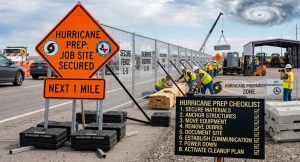

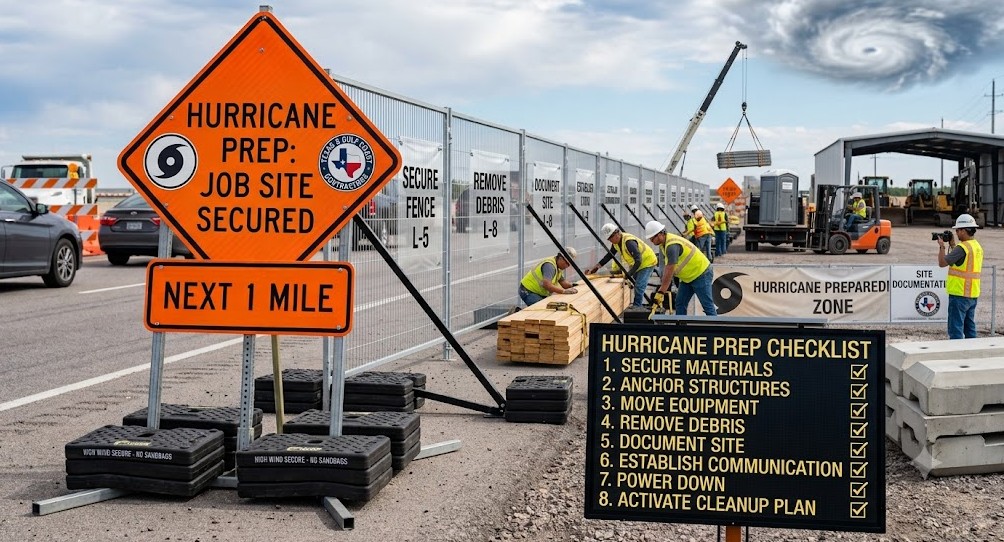
A hurricane can turn an ordinary construction site into a collection of windborne debris, damaged materials, blocked access routes, and unstable temporary structures in a matter of hours. For contractors along the Texas Gulf Coast, hurricane preparation is not simply about protecting finished work. It is about controlling everything that is temporary, exposed, movable, or vulnerable before severe weather arrives.
The most effective hurricane season jobsite prep checklist for Texas & Gulf Coast contractors starts well before the final hours before landfall. Contractors should identify loose materials, secure temporary fencing and barricades, protect equipment, clear drainage paths, establish shutdown procedures, and document site conditions.
This matters because hurricanes bring more than high winds. The National Hurricane Center identifies storm surge, heavy rainfall and inland flooding, high winds, and tornadoes among the major hazards associated with tropical cyclones.
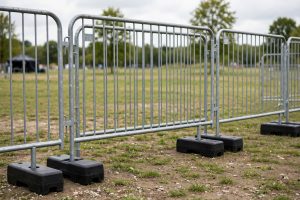
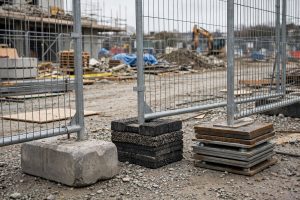
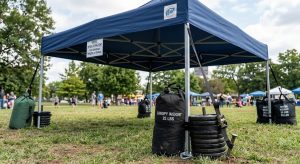
For temporary jobsite infrastructure, stabilization deserves particular attention. Reusable jobsite weights can give contractors a repeatable way to stabilize signs, barricades, fencing, and other temporary equipment without depending entirely on disposable sandbags.
Short Answer: What Should Contractors Do Before a Hurricane?
Before a hurricane threatens a construction site, contractors should:
- Remove or secure loose construction materials, tools, debris, signs, barriers, and temporary structures.
- Inspect temporary fencing, barricades, traffic-control devices, and access points.
- Move portable equipment and sensitive materials away from flood-prone areas.
- Protect exposed materials from wind and water.
- Clear drains, ditches, and temporary stormwater pathways.
- Establish equipment shutdown, worker evacuation, and communication procedures.
- Photograph the jobsite before the storm.
- Confirm that temporary equipment has adequate stabilization for the expected conditions.
The objective is simple: remove what can be removed, secure what must remain, protect what can be damaged, and document everything before conditions become unsafe.
Hurricane Season Jobsite Prep Checklist for Texas & Gulf Coast Contractors
Why Hurricane Preparation Is Different on Texas Gulf Coast Jobsites
Construction sites typically contain more temporary and unfinished components than completed properties. Temporary fencing, road signs, scaffolding, lumber, roofing materials, portable equipment, trailers, barricades, and storage areas can all be exposed to severe weather.
High winds can turn unsecured materials into dangerous projectiles. NOAA specifically notes that signs, roofing materials, siding, and other outdoor items can become windborne debris during hurricanes.
Texas Gulf Coast contractors must also account for:
- Heavy rainfall and flooding: Water can damage materials, equipment, and unfinished work while creating dangerous access conditions.
- Storm surge: Coastal projects may face rapidly rising water and access restrictions.
- Tornadoes: Tropical systems can produce tornadoes within rain bands, sometimes away from the storm’s center.
- Rapidly changing conditions: A jobsite that is safe to secure in the morning may become dangerous to access later.
That is why preparation should be treated as a repeatable operational process rather than a last-minute scramble.
What Contractors Should Secure Before a Hurricane
Start with anything that can move, tip, detach, float, or become damaged.
Prioritize:
- Temporary fencing
- Barricades and traffic-control equipment
- Construction and roadwork signs
- Tents and temporary shelters
- Portable equipment
- Generators and fuel-related equipment
- Scaffolding and temporary structures
- Roofing materials
- Lumber and insulation
- Pipes and pallets
- Tools and smaller equipment
- Containers and storage areas
- Lightweight debris and unused materials
When deciding whether to secure an item, ask three questions:
Can it move? Can wind or water damage it? Could it damage something else if it moves?
If the answer to any of these is yes, it belongs on the preparation list.
How Far in Advance Should a Jobsite Be Prepared?
Preparation should happen in stages.
Routine Hurricane-Season Preparation
Before any storm is approaching, identify vulnerable areas, establish responsibilities, inspect stabilization equipment, and maintain a site-specific hurricane checklist.
When a Storm Enters the Forecast
Begin reviewing materials, equipment, drainage, temporary structures, and evacuation plans. Do not wait for a warning before identifying what needs to move.
After a Hurricane Watch
Complete major securing and relocation work while conditions remain safe. Confirm that crews, subcontractors, suppliers, and site managers understand the plan.
Final Pre-Storm Securing
The final walkthrough should verify that nothing unnecessary remains exposed and that all critical temporary equipment is properly stabilized.
NOAA recommends preparing before hurricane season and taking action promptly when a storm threatens rather than waiting until conditions deteriorate.
Texas Hurricane Risks Contractors Need to Plan For
High Winds and Windborne Debris
Wind is one of the biggest threats to temporary construction equipment. Fencing panels, signs, plywood, roofing products, insulation, and lightweight materials can catch wind and move unexpectedly.
Temporary installations should therefore be inspected for connections, anchoring, stability, and exposure. Simply placing a heavy object nearby is not automatically an adequate stabilization method; the weight must be appropriate for the equipment, configuration, surface, and expected conditions.
Heavy Rain and Flooding
Flooding can damage equipment even when wind protection is adequate.
Contractors should:
- Clear drainage systems.
- Remove debris from water pathways.
- Move sensitive equipment to higher or protected locations.
- Protect materials from prolonged water exposure.
- Inspect temporary drainage and erosion-control measures.
The National Hurricane Center notes that tropical cyclones can produce substantial rainfall and flooding, including inland flooding.
Storm Surge and Coastal Flooding
Coastal Texas projects require additional planning. Storm surge can cause severe property damage and can travel inland from the coast.
Where appropriate, move equipment and materials to safer elevations and plan for the possibility that roads or site entrances may become inaccessible.
Tornadoes and Sudden Severe Weather
Hurricane preparation should also account for sudden severe weather. Tropical systems can generate tornadoes in embedded thunderstorms, meaning contractors should not assume that being outside the hurricane’s center eliminates wind-related risk.
Step-by-Step Hurricane Season Jobsite Preparation Guide
Step 1: Monitor the Storm and Establish a Trigger Point
Assign one person to monitor official weather information. Establish internal deadlines for securing materials, shutting down operations, and evacuating personnel.
Step 2: Inspect the Entire Jobsite
Walk the complete perimeter. Look for loose objects, unstable temporary structures, exposed materials, drainage problems, and vulnerable access points.
Take photographs before preparation begins.
Step 3: Secure Temporary Fencing and Barricades
Inspect fence panels, feet, connections, barricades, and traffic control equipment.
Identify locations where wind exposure is highest. Where additional stabilization is required, appropriate reusable jobsite weights can provide a repeatable solution for temporary equipment.
Step 4: Secure Signs and Traffic-Control Equipment
Inspect construction signs, roadwork signs, directional signs, barricades, channelizers, and related equipment.
A sign that appears stable under normal conditions may behave very differently when exposed to strong wind. Remove unnecessary signs and properly stabilize those that must remain.
Step 5: Secure Construction Materials
Secure or relocate lumber, roofing materials, insulation, pipes, pallets, containers, and lightweight debris.
Never assume materials will remain where they were stacked simply because they are heavy under normal conditions.
Step 6: Protect Tools, Machinery, and Equipment
Move portable equipment indoors whenever practical. Secure larger machinery and protect sensitive components from water.
Review fuel, batteries, electrical equipment, and manufacturer-specific shutdown requirements.
Step 7: Check Drainage and Stormwater Controls
Clear drains and temporary drainage systems. Remove debris that could block water flow and inspect erosion-control measures.
Step 8: Protect Temporary Buildings and Structures
Inspect jobsite trailers, storage containers, tents, shelters, scaffolding, temporary roofing, and coverings.
Follow engineered, manufacturer, and site-specific requirements for temporary structures rather than improvising stabilization methods.
Step 9: Establish Shutdown and Evacuation Procedures
Define when workers leave the site, which equipment must be shut down, how hazardous materials are secured, and how personnel will communicate.
Safety takes priority over completing last-minute site work.
Step 10: Complete a Final Pre-Storm Walkthrough
Confirm that loose materials are removed or secured, barriers are stabilized, signs are protected, drainage is clear, and equipment is protected.
Take a second set of photographs.
Step 11: Inspect the Site After the Storm
Do not re-enter an unsafe jobsite.
After authorized re-entry, inspect for structural damage, standing water, electrical hazards, damaged fencing, displaced barriers, and debris. Document damage before cleanup when appropriate.
Hurricane Season Jobsite Prep Checklist: What Should You Secure First?
Highest-Priority Items
- Loose construction materials
- Temporary signs
- Barricades
- Temporary fencing
- Tents and shelters
- Portable equipment
- Fuel and hazardous materials
Items That Can Often Be Removed
- Unnecessary signage
- Lightweight displays
- Unused materials
- Nonessential temporary structures
- Loose debris
Items That May Require Additional Stabilization
- Temporary fencing
- Barricades
- Traffic-control devices
- Construction signs
- Temporary structures
The rule is straightforward: removal is preferable when practical; stabilization is necessary when equipment must remain.
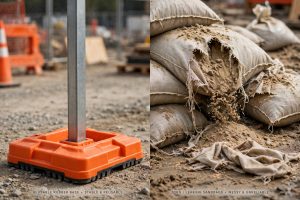
Sandbags vs. Reusable Jobsite Weights for Hurricane Preparation
| Factor | Traditional Sandbags | Reusable Jobsite Weights |
|---|---|---|
| Reusability | Limited | Designed for repeated use |
| Handling | Can be awkward and messy | Designed for easier handling |
| Storage | Often requires replacement/storage space | Reusable between projects |
| Cleanup | Sand and debris can remain | Less loose material |
| Repeated storm preparation | Requires ongoing replacement | Can be reused |
| Temporary barriers | Can provide weight | Purpose-built stabilization option |
| Multiple jobsites | Less convenient to manage repeatedly | Practical for repeated deployment |
When Sandbags May Still Be Appropriate
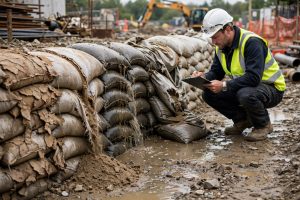
Sandbags can make sense for certain emergency, short-term, or flood-protection applications, particularly when they are already available and the goal is water control rather than simply adding ballast.
When Reusable Weights May Be the Better Option
Reusable weights can be particularly useful for contractors repeatedly stabilizing:
- Temporary fencing
- Barricades
- Construction signage
- Traffic-control equipment
- Temporary worksite structures
The key distinction is application. Sandbags are commonly associated with emergency flood protection, while purpose-designed weights can be a more convenient option when the recurring need is stabilization.
How The Stand Box TX Can Help Contractors Prepare Jobsites
Reusable Weights for Temporary Jobsite Equipment
The Stand Box TX provides reusable weight solutions designed to help stabilize temporary equipment without relying exclusively on disposable sandbags.
For contractors managing multiple projects or preparing for recurring severe weather, reusability can make storm preparation more organized. Instead of purchasing, filling, transporting, replacing, and disposing of sandbags for every event, contractors can maintain a reusable stabilization system as part of their jobsite equipment.
Potential applications include:
- Construction barricades
- Temporary fencing
- Jobsite signs
- Traffic-control equipment
- Temporary worksite structures
- Other equipment requiring additional stability
The value is not simply the weight itself. It is having a repeatable process for identifying vulnerable equipment and applying appropriate stabilization before severe weather arrives.
Why Reusable Weights Make Sense for Contractors
Reusable jobsite weights can help contractors:
- Prepare repeatedly across multiple projects
- Reduce dependence on disposable sand
- Keep stabilization equipment organized
- Reduce repeated replacement
- Maintain a cleaner jobsite
- Build stabilization into standard storm-preparation procedures
Contractors should still evaluate the specific equipment, installation method, surface conditions, manufacturer requirements, and expected weather before determining how much stabilization is appropriate.
Hurricane Preparation Checklist Contractors Can Print or Save
24–72 Hours Before Severe Weather
- Monitor official storm conditions
- Notify crews and subcontractors
- Inspect the entire site
- Remove unnecessary loose materials
- Secure temporary fencing
- Stabilize barricades
- Secure signs
- Protect equipment
- Clear drainage systems
- Secure temporary structures
- Protect sensitive materials
- Photograph the site
- Final Pre-Storm Check
All loose objects secured or removed
Temporary barriers stabilized
Signs secured
Equipment protected
Drainage pathways clear
Emergency contacts confirmed
Workers safely offsite when required
After the Hurricane
- Wait for authorization before returning
- Inspect structural hazards
- Check electrical hazards
- Inspect barriers and fencing
- Document damage
- Remove debris safely
Re-secure remaining temporary equipment
- Common Hurricane Jobsite Preparation Mistakes
- Waiting Until the Storm Is Too Close
- Last-minute preparation creates limited working time, potential supply shortages, and unnecessary exposure to worsening conditions.
- Using Inadequate Weight or Stabilization
- Putting an arbitrary heavy object on a barrier does not necessarily create a reliable stabilization system. Contractors should consider the equipment configuration, wind exposure, surface, connections, and applicable requirements.
- Leaving Lightweight Materials Exposed
- Plywood, insulation, roofing materials, packaging, signs, and debris can become dangerous windborne objects.
- Ignoring Temporary Fencing and Signs
- These are often overlooked because they are considered routine jobsite equipment. Yet their exposed surfaces make them particularly important to inspect before high winds.
- Failing to Document the Site
- Before-and-after photographs can establish the condition of equipment, materials, barriers, and structures and provide a useful record for project management and damage assessment.
- Frequently Asked Questions About Hurricane Jobsite Preparation
- What should contractors do to prepare a construction site for a hurricane?
- Remove unnecessary loose materials, secure temporary infrastructure, protect equipment, clear drainage systems, establish shutdown procedures, and document the site before severe weather arrives.
- How early should a construction site be secured before a hurricane?
- Routine preparation should happen throughout hurricane season. When a storm threatens the area, contractors should begin securing the site early enough to complete the work safely before dangerous conditions arrive.
- What construction materials should be secured before a storm?
- Lumber, roofing materials, insulation, pipes, pallets, containers, packaging, debris, and other lightweight or exposed materials should be secured or relocated.
- How do you secure temporary fencing during high winds?
- Inspect fence panels and connections, identify wind-exposed sections, follow the fencing system’s installation requirements, and use appropriate stabilization where needed.
- How do you keep construction signs and barricades from blowing over?
- Remove unnecessary signs and stabilize equipment that must remain. Appropriate reusable weights can provide additional ballast for compatible temporary equipment.
- Are sandbags effective for securing construction equipment?
- Sandbags can provide ballast in some applications, but they are not universally appropriate. Their suitability depends on the equipment, expected conditions, and purpose of stabilization.
- What can contractors use instead of sandbags on a jobsite?
- Depending on the application, contractors can use purpose-designed reusable jobsite weights for temporary fencing, barricades, signs, and traffic-control equipment.
- Are reusable weights better than sandbags for temporary barriers?
- For recurring stabilization of temporary barriers, reusable weights can be more convenient because they are designed for repeated use and do not require continual sandbag replacement.
- What should contractors do with equipment before a hurricane?
- Move portable equipment to protected locations where possible, secure larger machinery, protect sensitive components from water, and follow manufacturer-specific shutdown procedures.
- How should a construction site be inspected after a hurricane?
- Do not enter until authorized and conditions are considered safe. Then inspect for structural damage, electrical hazards, standing water, displaced equipment, damaged fencing, debris, and other hazards before resuming operations.
- Final Hurricane Season Jobsite Prep Checklist for Texas & Gulf Coast Contractors
- Effective hurricane preparation is not about rushing around the jobsite when landfall is approaching. It is about having a repeatable system that identifies vulnerabilities before they become emergencies.
- For Texas and Gulf Coast contractors, the priorities are clear: secure loose materials, stabilize temporary infrastructure, protect equipment, clear drainage, establish shutdown procedures, document the site, and get personnel out of harm’s way before conditions become dangerous.
- Temporary fencing, signs, barricades, and traffic-control equipment deserve particular attention because they are exposed, movable components that can become hazards when inadequately stabilized.
- For contractors who repeatedly manage these items across multiple jobsites, reusable jobsite weights such as those offered by The Stand Box TX can be a practical part of a broader storm-preparation strategy.
- Do not wait for the next hurricane warning to discover which parts of your jobsite are vulnerable.
- Walk the site now. Identify what can move. Remove what does not need to remain. Stabilize what must stay. Then turn the process into a repeatable hurricane jobsite preparation checklist your crew can use every storm season.