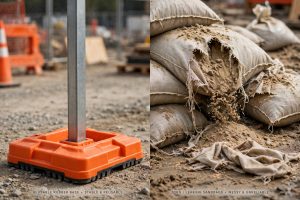

Once a crew gives up on sandbags, the next question is what replaces them, and concrete is the obvious answer. It is heavy, it is cheap, it lasts, and every site already has some form of it lying around somewhere. Rubber is the other answer, and it costs more per unit. Both are solid weights that never need refilling, which already puts either one ahead of a bag of sand, so the difference between them comes down to handling, surfaces, and what happens when something goes wrong.
Where Concrete Wins
Start here, because concrete has real advantages and pretending otherwise helps nobody make a decision.
It Is Cheaper Per Pound
Concrete is close to the cheapest mass a person can buy. A precast block or a poured base costs very little for what it weighs, and a crew with a mixer and some forms can produce it for less than that. When the only goal is to put a large amount of weight somewhere and leave it alone, concrete is difficult to argue against on price.
It Is Denser
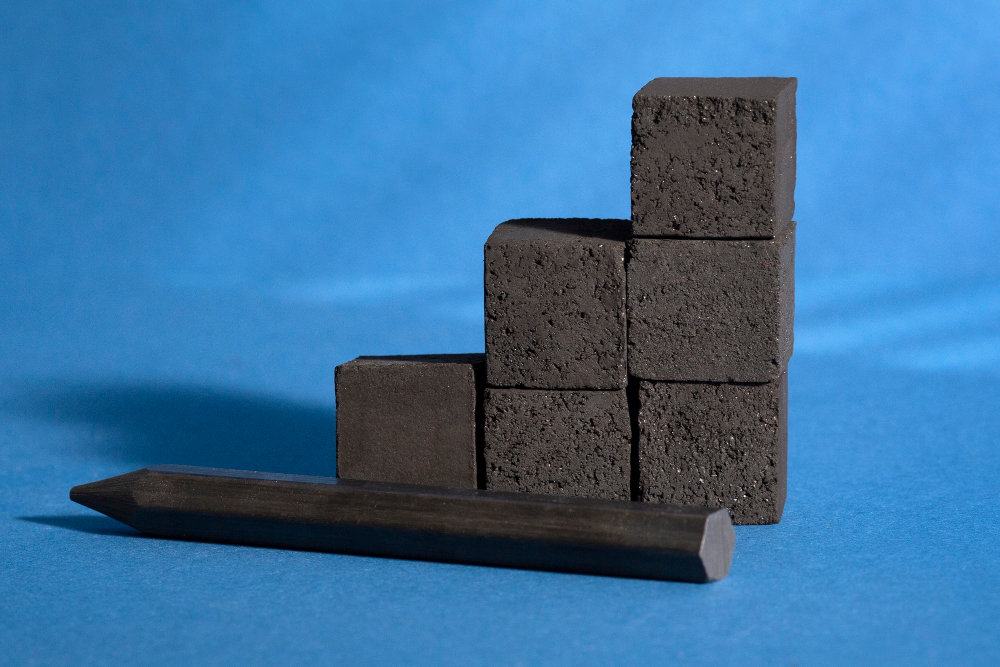
This matters more than people expect. Concrete is roughly twice as dense as compressed rubber, which means a concrete weight occupies about half the space of a rubber weight at the same poundage. For a fixed installation where the weight sits in one spot for a year, smaller is better, since it is less to trip over, less to store, and less in the way of the actual work.
It Lasts a Long Time Sitting Still
A concrete block left alone outdoors will outlast most things on a site. It does not rot, it does not care about sun, and nothing about a stationary block wears out. If the job is to weigh something down permanently and never touch it again, concrete does that job and keeps doing it for years without any attention.
Where Concrete Loses
The problems with concrete all begin the moment somebody has to pick it up or something has to hit it.
It Is Miserable to Handle
Concrete does not come with a handle, and the versions that do usually have a rebar loop or a rope cast into them that works right up until it does not. There is no good way to hold a concrete block, so crews end up carrying it against the chest, dropping it on their boots, and pinching fingers underneath it.
Thirty pounds of concrete is a two-hand job with no good grip anywhere on it. Thirty pounds of rubber with a molded handle is a one-hand job. On a shift where a crew places forty weights, that difference shows up in the schedule and eventually in the injury log.
It Chips, Cracks, & Spalls
This is the significant one. Concrete is strong under compression and weak everywhere else, so dropping it on a corner breaks the corner off, and dropping it on pavement enough times starts it coming apart in pieces. Once a block chips, those pieces go somewhere, and on a highway shoulder loose concrete near live traffic is debris that gets thrown by tires. A rubber weight dropped on the same corner bounces and keeps working.
Freeze and thaw makes it worse. Water gets into the pores, freezes, expands, and pushes the surface off, so crews in cold climates watch concrete weights spall a little more every winter until they are no longer usable.
It Damages What It Touches
Set a concrete block on finished asphalt, a parking deck, a sidewalk, a storefront floor, or a client’s driveway and it leaves a mark. It scratches, it stains, and if somebody drops it, the surface underneath cracks. Rubber does none of that, since it sits on a finished surface without marking it, which is why event crews, facility managers, and anyone working in front of a customer keep choosing it.
It Does Not Grip Anything
A concrete block is a block, so setting it next to a sign foot means it rests there and nothing more. When wind lifts the sign, the frame comes up and the block stays on the ground, which is the same geometry problem sandbags have.
The Stand Box is molded with dual channels in the base that fit over the feet of temporary road signs and fence frames, so the weight locks onto the structure and the two move as one piece. A poured block cannot do that unless somebody forms it specifically for the hardware, and almost nobody does.
It Hurts
Thirty pounds of concrete landing on a foot is a different injury from thirty pounds of rubber landing on a foot, because concrete is rigid and concentrates the impact on whatever edge hits first while rubber gives. The same logic applies to vehicles. A concrete weight struck by a car becomes a projectile with a hard edge, while a rubber weight in the same situation deforms and absorbs part of it. For anything sitting near live traffic, that is worth thinking about before it happens.
Where Rubber Wins
Everything concrete struggles with traces back to the same source, which is that concrete was never meant to be moved by hand or hit by anything. Rubber was, and the advantages below all follow from that difference.
It Gets Handled Correctly
The Stand Box has a molded handle through the body, so it gets carried rather than dragged, wrestled, or hugged against somebody’s chest. Equipment that is easy to handle correctly gets handled correctly, and that accounts for most of the reason it holds up over years of use.
It Stacks & Locks
Interlocking knobs on top and matching holes on the bottom let units stack and stay stacked. Concrete blocks stacked on each other slide, and a sliding stack of concrete near a working crew is a bad afternoon waiting to happen. Stacking also lets a crew build to whatever weight a setup calls for in known 30 pound increments, and trust that the stack will hold together when the wind arrives.
It Survives Being Used
Rubber takes impact, abrasion, and handling without breaking down, which traces back to the fact that it came from tires and spent its first life on hot asphalt taking worse punishment than any weight duty involves. Drop it, kick it, run it over, throw it in a trailer, or leave it out all winter, and it comes back the same. Concrete survives sitting still, while rubber survives being used, and most job sites involve being used.
It Will Not Float & Will Not Rot
Both materials handle water better than fabric does, and neither one floats. Rubber has the edge in freeze and thaw, since it has no pores for water to fill and nothing on the surface that can spall off when that water expands.
The Honest Case Against Rubber
Rubber is not the answer for everything, and there are situations where recommending it would be wrong.
It costs more per unit. The Stand Box is $44.95, and a concrete block of similar weight can be a fraction of that, particularly if a crew pours it themselves. For a buyer who needs mass and nothing else, that gap is real and it matters.
It is bulkier at the same weight, because it is less dense. If space on a site is tight and the weight is going to sit in one place forever, concrete puts more pounds into a smaller footprint. It also ships at full weight, so freight costs more than most people expect when they place the order.
And it is molded for specific hardware. The channels fit standard temporary sign and fence feet, while concrete can be poured into any shape a crew wants to form, including custom shapes for odd equipment that no manufacturer supports.
How to Choose
The decision comes down to a single question, which is how often the weight moves.
Choose concrete when the weight goes down once and stays there for a year. That covers permanent installations, fixed barriers, anchoring something that will not be relocated, and any situation where the surface underneath does not matter. Nobody is carrying it, nothing is going to drop it, and cheap mass is the entire goal.
Choose rubber when the weight gets picked up. That covers traffic control crews resetting signs weekly, event operators loading in and out every weekend, fence companies moving panels as a job progresses, anyone working on finished surfaces, anyone whose weights sit near live traffic, and anyone whose crew is doing the lifting. Most outdoor work falls into this second group, which is why rubber has taken over the portable end of this market while concrete keeps the permanent end.
The Last Word
Concrete is cheap, dense, and durable for as long as nothing touches it. It is also brutal to handle, it chips and spalls, it damages finished surfaces, it does not grip the thing it is holding, and it hurts whatever it lands on.
Rubber costs more and takes up more room per pound. In exchange it carries by a handle, stacks and locks, takes impact without breaking apart, sits on a client’s driveway without leaving a mark, and molds around a sign foot so the weight and the sign stay together.
The Stand Box is 30 pounds of solid compressed recycled rubber with base channels sized for temporary sign and fence feet, interlocking knobs for stacking, and a molded handle through the body. It was built by Jodi Carter, a Marine Corps veteran, after years of watching sandbags fail at a traffic control company. For weights that sit still forever, pour concrete. For weights a crew actually picks up, this is the one that makes sense.