

Ask ten crews what they use to hold down signs and most will say sandbags, and most will complain about them in the same breath. Sandbags are the thing everybody uses and nobody defends. Rubber weights are the alternative that keeps coming up, and crews want to know one thing before they spend the money. They want to know if the switch pays off or if it is just a more expensive way to do the same job. Here is the honest comparison, feature by feature, including where sandbags still make sense.
Start with what sandbags do well, because they do have a case. They are cheap, since a bag costs a dollar or two and sand is close to free in most places. They are available everywhere, from any supply house or hardware store, on no notice at all. They are light to carry empty, so a crew can bring a hundred flat bags in a truck and fill them on site. They also mold to whatever they sit on, which means one bag fits any shape a crew puts it against.
For a short job in dry weather, that combination is hard to beat. If a crew is setting a sign for three days in July and taking it down before any weather arrives, sand does the work and costs almost nothing. Nobody should feel bad about using a sandbag in that situation. The case falls apart when the timeline stretches or the weather turns.
The failures below are not unusual events or signs of a bad batch. They are the normal service life of a fabric bag full of loose material sitting outdoors, and they arrive in roughly the same order on every site.
This is the failure nobody catches in time. A bag tears on gravel, on a metal sign foot, or on a bolt head, and the tear is small enough that the sand runs out slowly rather than all at once. A bag that held 40 pounds in spring is holding 25 by midsummer, and no one weighs it. The sign stands fine until the first real gust, and then it does not.
The dangerous part is that the failure is invisible while it is happening. A leaking bag looks exactly like a working bag right up to the moment it stops holding, which means there is no point at which anyone has a reason to intervene.
Fabric soaks up rain, and while wet sand is heavier than dry sand, that added weight is not the improvement it sounds like. The water rots the bag from the inside and the sun finishes the job from the outside. A bag that sat through one season is brittle before the next one starts, and bags stored wet come back out of the trailer moldy.
Standing water is where sandbags give up entirely. A partly empty bag floats, and a soaked one slides on wet pavement, and either way the sign or barricade it was holding goes with it. Storm season is exactly when a weight needs to work, and it is exactly when sand does not.
A sandbag is a loose sack, so when it is draped over a sign foot the sand inside settles, the bag moves, and it ends up beside the foot rather than on it. When wind lifts the sign, the frame comes up out from under the bag while the weight stays on the ground. The bag did not fail in any way a crew would notice, because it was never connected to the thing it was supposed to be holding.
Filling, hauling, topping off, and replacing are all labor, and every hour of that labor gets billed to somebody while producing nothing. The work is spread thin enough across a season that it rarely gets counted, which is the only reason it survives review.
The advantages below are not about rubber being a tougher material in some abstract sense. They come from the fact that a solid weight has almost nothing that can go wrong with it, and that the shape can be molded to do a job a loose bag was never able to do.
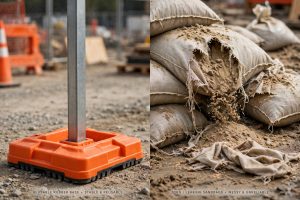
A rubber weight is solid all the way through. The Stand Box is molded from 96% compressed recycled rubber with a 4% compound, and there is nothing inside it that could leave. It weighs 30 pounds on the day it arrives and 30 pounds three years later, and the number does not move when it is wet, dry, hot, or frozen.
That reliability is worth more than it first sounds. A crew that knows every weight on site is 30 pounds can plan a setup around a real number, while a crew running sandbags is working from an estimate that gets worse every month.
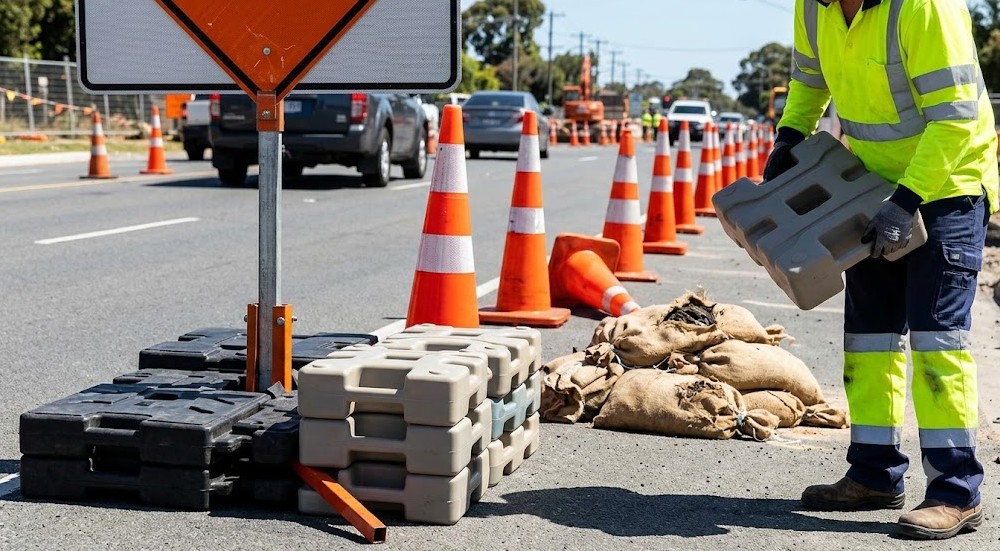
This is the part most comparisons miss, and it matters more than the weight itself. The bottom of the Stand Box is molded with dual channels that fit over the feet of temporary road signs and fence frames, so the weight grips the base rather than resting near it. When wind pushes the sign, the weight and the frame move as one piece, which means they do not move at all. Thirty pounds locked onto a base outperforms fifty pounds sitting beside one, because shape does more work here than mass does.
Rubber stays down in standing water, since there is no air space inside the unit for the water to lift and nothing about it that wants to rise. On a flooded shoulder, in a filled trench, or through a storm, the weight is where the crew left it, which is the one condition sandbags cannot manage.
Interlocking knobs on top and matching holes on the bottom let units lock together, so when a device needs 60 pounds a second unit goes on and stays on. A stack of sandbags slides apart under the first load that hits it, while a stack of rubber holds as a single mass.
There is no filling station, no sand pile, and no stack of split bags behind the shop. The weight comes off the truck ready to use, goes onto the sign in seconds, and goes back on the truck at the end of the job with nothing needed in between.
Sandbags rot in a trailer and come out of winter storage moldy, brittle, and holding a fraction of what they went in with. Rubber sits in that same trailer for six months and comes out identical to how it went in, which for an operator who works seasonally eliminates an entire annual replacement bill.
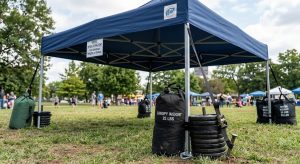
This matters more in event and client-facing work than it does on a highway shoulder. A row of split, stained sandbags around a client’s tent or a storefront sign says something about the operation, and a set of molded rubber weights says something different. It is not the main reason anyone switches, but operators who work in front of customers bring it up on their own.
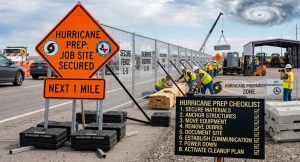
The comparison is not only about cost, because weight is a safety device and it deserves to be judged the way other safety equipment is judged. The MUTCD and local guidelines set out how signs and barricades should look and where they belong in a work zone, and every one of those requirements assumes the device is standing. A barricade lying on its side meets no standard and warns nobody, which makes the weight the part that keeps the rest of the setup compliant.
That is what makes the invisible failure of a leaking sandbag more serious than it first appears. The crew believes the work zone is secured, the paperwork says it is secured, and the bag holding it says otherwise, and nobody finds out until a driver does. A weight that holds a known 30 pounds for years removes that variable entirely, which is one less thing on a site that can quietly stop working while everyone assumes it is fine.
Rubber is not free of tradeoffs, and pretending otherwise would be useless to anyone making this decision. The purchase price is higher, at $44.95 against a dollar or two for a bag, and that is a real number when a crew needs two hundred weights. It is also the reason the switch usually happens in stages rather than all at once.
Rubber weights are heavy to transport even when they are sitting unused in the truck. Sandbags ship flat and get filled on site, while rubber ships at full weight, which means freight costs more and a truck carries fewer units. For a crew working far from the yard, that is worth accounting for before placing a large order.
A molded weight also fits what it was molded for. The channels on the Stand Box fit standard temporary sign and fence feet, while a sandbag drapes over anything, and that flexibility is the one thing sand genuinely does better. If a crew runs unusual hardware, the fit is worth confirming before buying in volume.
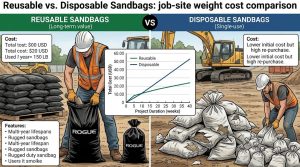
Sandbags win the invoice and lose the year, which only becomes visible when the full cost gets run rather than the purchase price. Bags get replaced as they tear, which on barricade duty can happen several times a season. Crews stop to refill leaking bags, and that labor is billed to something. Sand gets stored, hauled, and filled before it ever reaches a sign, and wet bags get thrown out at the end of the season and bought again in the spring.
Then there is the cost of failure, which does not appear on any invoice at all. One sign down in a live lane can mean a callout, a citation, or a claim, and that single event can cost more than a full set of rubber weights would have.
The Stand Box gets bought once. It works through the season, comes back for the next one, and keeps going for years after that. The unit that costs more at purchase costs less by the time the year closes, and crews that track the full number tend to land in the same place.
The answer is not the same for every job, and a supplier who tells you that it is actually deserves to be ignored. Use sandbags when the job is short, the weather is dry, and the setup comes down before anything changes, because a three-day sign in a dry month does not need a rubber weight and there is no reason to spend more on one.
Use rubber weights when the setup stands for weeks, when storm season is running, when the site floods, when the same crew sets the same signs every week, or when a sign going down would create a real hazard. That covers most traffic control work, most construction, and most event work. Plenty of shops keep both on hand, using bags for the quick dry jobs and rubber for everything that has to hold, and that is a reasonable place to land.
Sandbags are cheap on the invoice and expensive across a season. They leak, rot, float, and shift, and the failure stays invisible until the moment it is not.
Rubber weights cost more at purchase, weigh more to ship, and fit what they were built to fit. In exchange they hold their mass for years, lock onto the base, stay down in water, stack without sliding, and never need refilling. The Stand Box was built by Jodi Carter after years of replacing broken sandbags at a traffic control company, which is to say it was designed by someone who lost this argument to sand often enough to do something about it.