
There is a particular smell that comes out of a trailer the first time it gets opened in the spring, and anyone who has run an event company or a seasonal crew knows exactly what it is. The sandbags went in wet at the end of the last job, the door closed, and for four or five months nothing happened to them except time. What comes out is a stack of bags that are stained, soft in places, growing something, and heading for a dumpster rather than a job site.
This failure is different from the others in one important way. Every other way a sandbag dies happens while it is doing work. This one happens while it is doing nothing at all, which is why it is so easy to overlook and so annoying when it lands.
Why Bags Grow Things
Mold needs three things, and a stored sandbag supplies all of them without any effort.
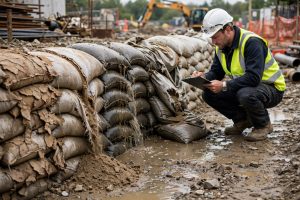
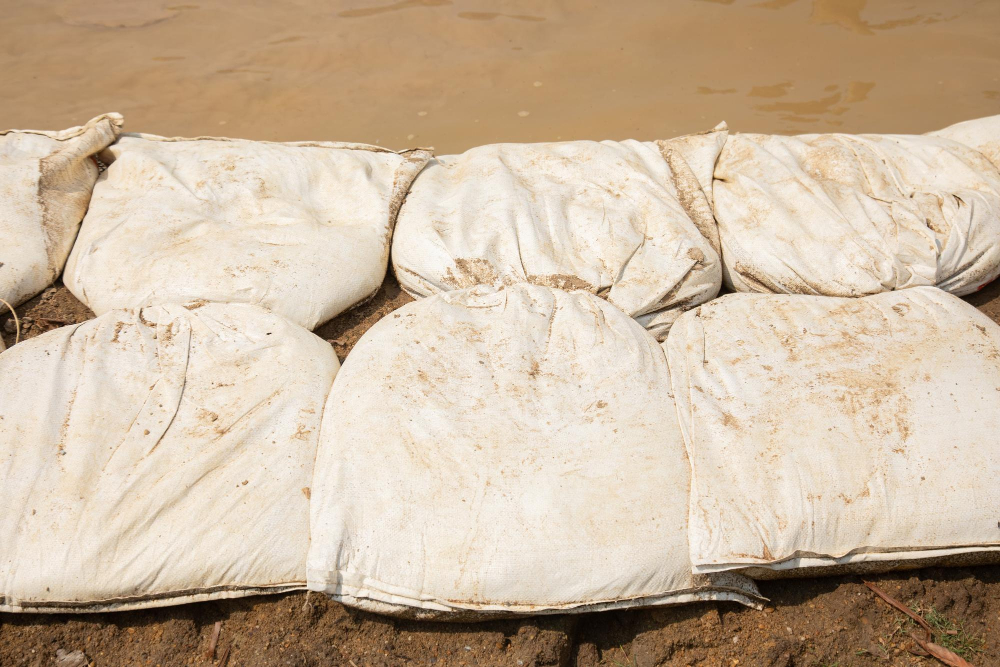
The first is moisture, which the bag brings in with it. A bag that came off a wet site is carrying water in the fabric weave and water held between the sand grains, and neither of those dries out once the bag is stacked in a pile with other wet bags. The middle of that stack has no airflow and no sunlight, so the moisture that went in stays in for as long as the bags sit there.
The second is organic material, and this is where the choice of bag matters. Burlap is organic by definition, so it is food. Polypropylene is not, which sounds like it should end the problem, but the fabric traps dust, dirt, grass, and organic debris from the site in the weave, and that layer is enough. The bag does not have to be edible for something to grow on it.
The third is a stable temperature with no light, which is a fair description of the inside of a closed trailer or the back of a storage container. Nothing about that environment discourages anything.
Give it four months and the result is predictable. It is not a sign that anyone did anything wrong. It is what happens when you put wet fabric in a dark box and leave it alone.
What Mold Actually Does to the Bag
The staining and the smell are the visible part, and if that were all of it, most crews would shrug and use the bags anyway. The real damage is structural, and it is happening underneath.
Growth in the weave breaks down the fibers holding the bag together. Burlap loses strength quickly because the material itself is being consumed. Polypropylene holds up better, but the combination of constant moisture, the acids that biological growth produces, and months of sitting under load in a stack leaves the fabric weaker than it went in. A bag that would have taken another season of work tears the first time somebody picks it up.
That is the version most crews actually experience. Not a bag that looks rotten, but a bag that looks passable and then comes apart in their hands on the first day of the season. The mold did its work quietly and the failure showed up as a handling problem months later.
Why This Costs More Than It Looks
The replacement order is the obvious cost and it is the smaller half. The larger half is timing, because this failure is discovered at the worst possible moment. Nobody opens the trailer in January to check on the sandbags. The stock gets pulled the day before the first job of the season, which means the discovery that half of it is unusable happens when the crew is already loading. Now somebody is buying bags in a hurry, filling them in a hurry, and the season starts behind.
There is also the disposal side, which quietly doubles the cost of every bag involved. The bag was paid for once when it was bought and again when somebody had to haul it away. Moldy bags are not going in a corner to be dealt with later, they are going in a dumpster, and that is a fee attached to something that was supposed to be the cheap option.
And for anyone working in front of customers, there is a version of this cost that never appears on any invoice. Event operators, rental companies, and anyone setting up on a client’s property are handling this stock in view of the person paying them. Pulling stained, foul-smelling bags out of a trailer and arranging them around a wedding tent or a corporate function is not a neutral act. Nobody says anything, and it registers anyway.
The Storage Habits That Help
There are things worth doing if sandbags are what you have, and they are worth being honest about, because they slow the problem down rather than ending it.
Drying bags before storage is the single most useful step. Bags spread out in the sun for a day before they go in the trailer come out of storage in far better shape than bags that went in soaked, because the moisture that feeds everything is gone before the door closes. The difficulty is that this requires space, a dry day, and someone with the time to do it at the end of a season when everyone is tired and the trailer is right there.
Airflow in storage helps for the same reason. Bags on a pallet with room around them fare better than bags packed into a solid block, since the ones in the middle of a tight stack are the ones that come out worst. Storing them somewhere with ventilation rather than a sealed container makes a real difference.
Cleaning site debris off the fabric before storage removes some of what the growth is feeding on, though this is the step that realistically never happens, and nobody should pretend otherwise.
All of that together buys you a better spring. None of it changes the fact that you are storing damp fabric for months and hoping.
What Comes Out the Same Way It Went In
The reason this problem disappears with a solid weight is not that rubber is treated against mold. It is that there is nothing there for the process to work with.
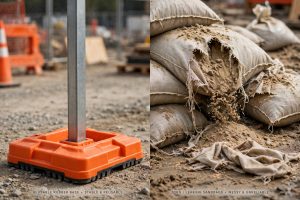
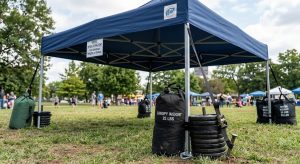
The Stand Box is a single piece of compressed recycled rubber with nothing inside it. Water does not soak into it, so a unit that comes off a wet site in November is not carrying moisture into the trailer the way a bag is. There is no weave to trap dirt and organic debris, so there is nothing for growth to feed on even if moisture were present. There is no fabric whose fibers could be broken down, and no seam that could weaken while sitting in a pile.
The interlocking knobs on the top and the matching holes on the bottom mean the units stack into a stable block for storage rather than a loose heap that shifts every time the trailer takes a corner. They sit through the off-season taking no damage from sitting.
What comes out in the spring is what went in. Same 30 pounds, same shape, ready to load. The pre-season routine loses an entire step, because there is nothing to inspect, nothing to throw away, and no emergency order to place the day before the first job.
Key Takeaway
Sandbags get moldy because wet fabric in a dark trailer is a good place for things to grow, and because the moisture, the debris in the weave, and the closed dark space all arrive together at the end of every season. Drying and ventilating the stock buys time and does not solve it, since the underlying situation is unchanged.
The genuinely irritating part is that this is the one failure that happens while the bags are doing nothing. They survived the whole season, came off the site intact, and died in storage. If your spring routine includes opening a trailer and throwing away half of what is in it, that is the cost of storing damp fabric, and it repeats every year until the fabric goes away.