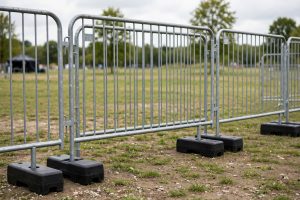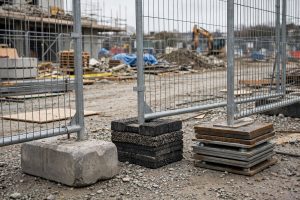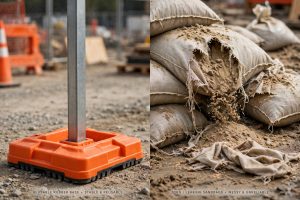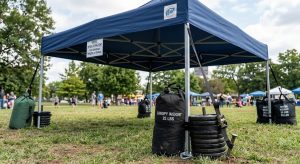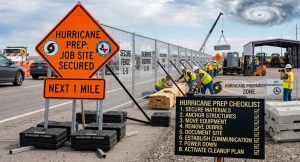

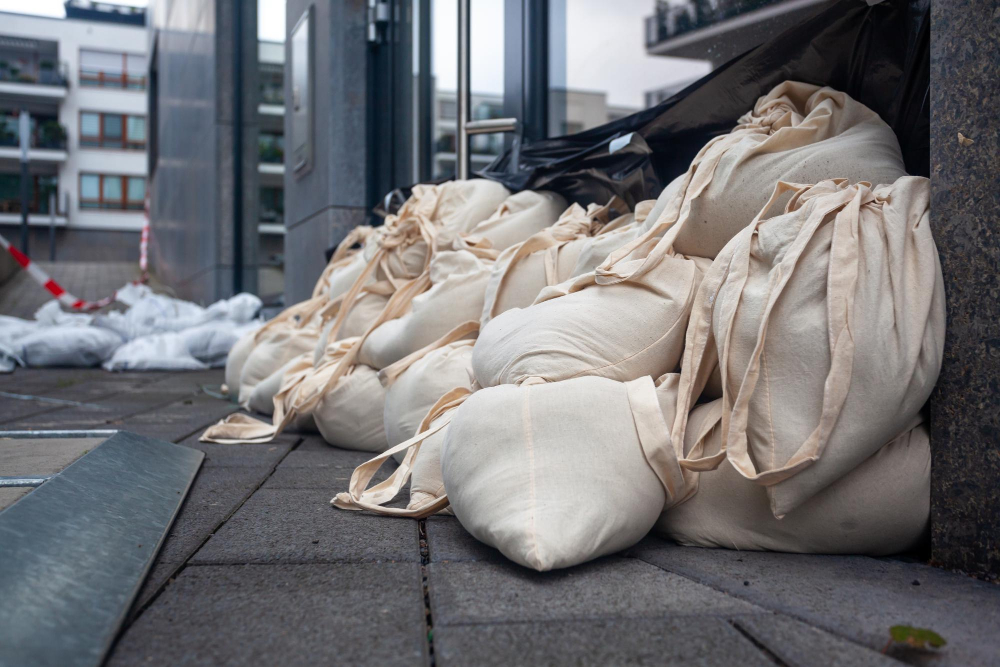
Sandbags cost a dollar or two. That number sits on the invoice, it is easy to defend in a budget meeting, and it is the reason most crews are still using them. It is also the smallest part of what they actually cost.
The rest of the bill shows up in places nobody tracks. Labor gets absorbed into other line items, replacements get reordered without anyone counting, and storage, hauling, and disposal never appear under a heading anyone recognizes. Then there is the cost that lands all at once, which is what happens when a bag fails and a sign goes down. This is a look at the full number.
The Purchase Price Is the Cheapest Part
Start with what everyone sees. A bag is a dollar or two, sand is nearly free, and a crew can outfit a site for the cost of lunch. That is the number that gets compared against a $44.95 rubber weight, and on that comparison sand wins by a wide margin. If the comparison were fair, this article would not need to exist.
The comparison is not fair, because a sandbag is not a purchase. It is a subscription. You do not buy it once, you buy it, fill it, refill it, replace it, throw it away, and buy it again, and the invoice only ever shows the first step in that sequence.
Cost One: Filling
Somebody has to put the sand in the bag, which means a person on the clock standing at a sand pile with a shovel, doing work that produces nothing. That happens at the start of every project and again every time the stock runs down over the course of a season.
Nobody bills a client for bag filling as a line item, so it disappears into general labor, which is exactly why it never gets counted. It is real money and it is invisible money at the same time. Run the number for your own shop by taking how long it takes one person to fill a day’s worth of bags, multiplying by your loaded labor rate, and multiplying that by how many times a season it happens. Most people are surprised by the result, and it is the smallest of the costs on this list.
Cost Two: Hauling & Storage
Sand is heavy and it has to live somewhere. There is a pile in the yard, or there are pallets of filled bags taking up space that could hold something that earns money. They get loaded into trucks, which uses payload capacity and fuel, and they get moved around the site every time the work shifts.
Filled bags ship at full weight, the same as rubber does, so that particular advantage evens out the moment the bags are filled. The difference is that rubber gets loaded once and used for years, while sand gets loaded every season and thrown away at the end of it.
Cost Three: Refilling & Topping Off
This is where the total starts climbing. Bags leak, because a tear opens on a sign foot or on gravel and sand runs out slowly, and the correct response is for somebody to notice, get more sand, and top it off.
The problem is that this almost never happens, since a leaking bag looks exactly like a working bag and there is no alarm attached to it anywhere. The sign is still standing, so everybody drives past it without a second thought. That means the cost of refilling shows up in one of two ways. Either a crew does it, which is labor nobody billed for, or a crew does not do it, which becomes the failure cost described further down. There is no version of this where the cost is zero.
Cost Four: Replacement
Bags do not last a season on hard duty. Barricade work is the worst case, because the device rocks in the wind, the fabric grinds against a metal edge, and bags tear out several times a year. Sign duty is gentler and still consumes stock steadily. Sun makes the fabric brittle, freeze and thaw splits the seams, and water rots whatever is left of it.
Every one of those is a reorder, and reorders are small enough individually that they get approved without thought and never get totaled at the end of the year. If you want the real number, pull twelve months of purchase orders and add up every line that says sandbag. Most shops have never done this, and the total tends to land harder than anyone expects.
Cost Five: Disposal
At the end of the season the wet stock comes off the site and goes into a trailer, and six months later it comes out moldy and brittle and goes into a dumpster. So the bags got paid for twice, once to buy and once to haul away, and then the spring order starts the entire cycle over again.
Sand that ends up spread across a shoulder from a torn bag is its own small cleanup. On some sites, loose sand near a drain or inside a chemical plant is a problem in its own right rather than simply a mess to sweep up.
Cost Six: The Failure
This is the one that makes everything above look like rounding errors. A sign or barricade goes down in a live lane, and what happens next depends entirely on the day.
On a good day, somebody calls it in, a crew rolls out, resets the device, and the only cost is the callout and the hours attached to it. On a worse day an inspector sees an out-of-compliance work zone and writes it up. On the worst day it becomes a claim, because a driver hit the device or hit something that was supposed to be marked and was not.
Any one of those events can cost more than outfitting the entire site with weights that would not have failed, and the claim version can cost more than the weights for every site the company runs. The part worth sitting with is that this failure was invisible right up until it happened. The bag had been emptying itself for months, the setup looked correct, the paperwork was right, and nobody was negligent in any way that anyone would have recognized at the time. That is the actual hidden cost, and it is not the money. It is that the failure gives no warning.
Cost Seven: Compliance Exposure
The MUTCD and local guidelines specify how devices should look and where they belong in a work zone, and every one of those requirements assumes the device is upright. A barricade on its side meets none of them.
If an inspector or an attorney is looking at a site after an incident, the question of what was holding the device down becomes a question somebody has to answer. A weight that quietly lost 40 percent of its mass is a hard thing to defend, and a shop with no maintenance record on its weights has nothing to point to when asked. Solid weights make that question boring, because each one is 30 pounds, it was 30 pounds when it was bought, and it is 30 pounds now. There is nothing to inspect and nothing to explain.
Running Your Own Number
None of this is useful as somebody else’s arithmetic, because every operation is different and a made-up average would not describe yours. Here is the framework to run it on your own books.
Take one site’s worth of weights and add the purchase cost of the bags for a year, including every reorder. Add the labor hours for filling at your loaded rate, then add the hours spent topping off and resetting devices. Add disposal at the end of the season. Then look at your incident history and ask honestly how many resets, callouts, or claims traced back to a weight that had already failed.
Put that total next to the one-time cost of solid weights that need none of it. For most crews doing regular outdoor work, the crossover happens inside the first year, and every year after that is clear. For a shop that sets a sign three days a year in dry weather, it will not, and that shop should keep using sandbags. This is not an argument that sand is never the right answer. It is an argument that the invoice price is not the price.
What Removes These Costs
Every cost on this list traces to two facts. The bag is fabric, and the bag holds loose material.
The Stand Box removes both. It is 30 pounds of solid compressed recycled rubber, so there is no fabric to tear and nothing inside that could leak out. It does not need filling, topping off, or replacing, and it does not rot in storage, go brittle in the sun, split in a freeze, or float in standing water. The base is molded with dual channels that fit over the feet of temporary road signs and fencing, so it grips the frame rather than sliding off it, and a molded handle means one person places it in seconds.
It costs $44.95, once. Then it goes out, comes back, and goes out again for years. It was built by Jodi Carter, a Marine Corps veteran who spent years at a traffic control company replacing broken sandbags and eventually decided that the cheapest option was the most expensive thing on the truck.
The Bottom Line
Sandbags are cheap to buy and expensive to own. The purchase price is the only part anybody tracks, and it is the smallest part of the total. Filling, hauling, refilling, replacing, and disposal are real costs that hide inside other line items, and the failure cost hides completely until the day it does not.
Pull your purchase orders and add the labor, then look at your callouts. The number is already sitting in your books, and it has been there the whole time.