The number depends on your frame, your site, and the rules where you are working, and any source that hands you a single figure without asking those questions is guessing on your behalf. Tent ballast is one of the few areas in this trade where getting it wrong has genuinely serious consequences, so here is how to find the number that applies to your setup rather than a number that sounds about right.
The Three Places Your Number Comes From
Start with the tent manufacturer. Frame makers publish ballast requirements for their products, and those figures come from testing the actual frame rather than from a general rule. That specification is the baseline and it is the first thing to pull, because it costs nothing and it is specific to the equipment in your trailer.
Then check the venue and the permit. Municipalities, event venues, fairgrounds, and permitting authorities frequently set their own minimums for temporary structures, and those requirements are not optional. On a permitted event, that number governs regardless of what the manufacturer says, and it is often higher.
Then look at your site and your conditions. An open parking lot with nothing upwind is a different situation from a courtyard surrounded by buildings. A frame that is going up for four hours in settled weather is different from one standing for three days through a forecast. The published figures are minimums, and minimums assume conditions somebody else imagined.
Build to whichever of those three numbers is highest. That is the entire method, and it is more reliable than any figure this page could give you.
Why the Rule of Thumb Is Not Enough
There are numbers that circulate widely in the event trade, and crews repeat them because they are easy to remember. The trouble is that a rule of thumb was derived from a specific frame in specific conditions, and it travels far from that origin without anyone noticing. Your frame is not that frame and your lot is not that lot. If something goes wrong at a permitted event, the question of what standard you built to gets asked by people who will not accept a rule of thumb as an answer, so pull the actual specification. It takes ten minutes and it is the difference between a defensible setup and a guess that happened to work most of the time.
Every Leg, Not Some of Them
A canopy behaves like a wing rather than a wall. Air moving across a lot slips under the peak and pushes up against the underside of the top, which is a lift working against gravity rather than a shove from the side. The frame gets lighter, the legs get easier to move, and then side load walks the whole thing across the pavement.
That is why tents fail at one corner. The upwind leg takes the lift first, that corner comes up, and the rest follows it over. Anchoring three legs well and one leg badly gives you a tent held down by the one bad leg, so the ballast requirement applies to every leg rather than to the tent as a whole.
The Connection Matters As Much As the Mass
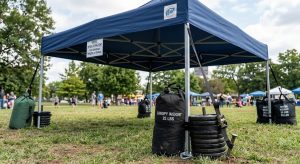
Weight sitting near a leg does nothing at the moment the leg lifts. A sandbag draped over a foot or leaning against a leg is not connected to it, so the frame comes up, the bag stays down, and the tent is free to go. The bag can be full and intact and still contribute nothing when it is actually needed.
Ballast has to be tied, strapped, or otherwise linked to the leg. Regardless of what you are using, the connection between the weight and the frame is the part doing the work, and it is the part crews skip most often because it takes an extra minute per leg.
The Number You Actually Have
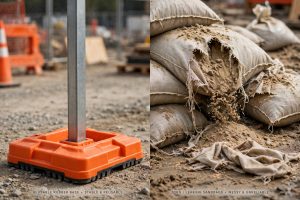
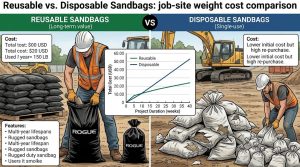
Here is the problem that undermines every calculation above, and it applies to anyone running sandbags. Bags lose weight quietly. They get dragged across asphalt during setup and teardown, the fabric wears through, and sand runs out through the opening a little at a time. A bag that started at 40 pounds is holding 25 by the middle of the season, and nobody weighs it because the tent stood up last weekend and everyone assumes the bags are doing their job.
So an operator can pull the right specification, do the math correctly, and place ballast on every leg, and still be under the required weight, because the bags stopped matching their labels months ago. An operator running events every weekend is working with a set of weights that gets lighter all season, and the tent is fine until the one windy Saturday, which is precisely the day it matters.
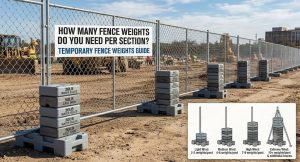
The Stand Box addresses that by being solid. It is 30 pounds of compressed recycled rubber with nothing inside it to leak, so it weighs 30 pounds this weekend and 30 pounds three years from now, wet or dry. Placed upright on the foot of each leg and secured to the frame, it holds a known quantity, and interlocking knobs on top with matching holes on the bottom let units stack when a frame calls for more than 30 pounds per leg. Building to a specification is only possible when you know what your weights actually weigh.
What No Ballast Will Do
This is the part that matters more than the rest of the page. No anchoring setup makes a canopy safe in a storm. Ballast buys margin in ordinary wind, and it is not a substitute for taking the tent down when conditions turn. A canopy tumbling through a crowd is the outcome this entire question exists to prevent, and the crews who avoid it are the ones willing to call it early rather than the ones who added two more weights and hoped.
Watch the forecast, set a wind threshold before the event rather than during it, and take it down when you hit that threshold. That decision has saved more tents than any weight ever sold.
Summing It Up
Pull the ballast specification from your tent manufacturer, check the requirement set by your venue or permit, look honestly at your site and forecast, and build to the highest of the three. Put weight on every leg rather than the windward ones, and connect it to the frame rather than resting it nearby.
Then confirm your weights weigh what you think they weigh, because a correct calculation built on sandbags that emptied themselves over the summer is not a correct setup. And take the tent down when the wind says to.