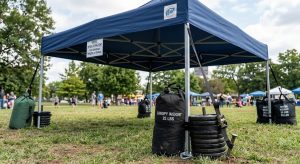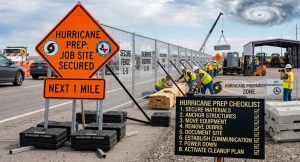

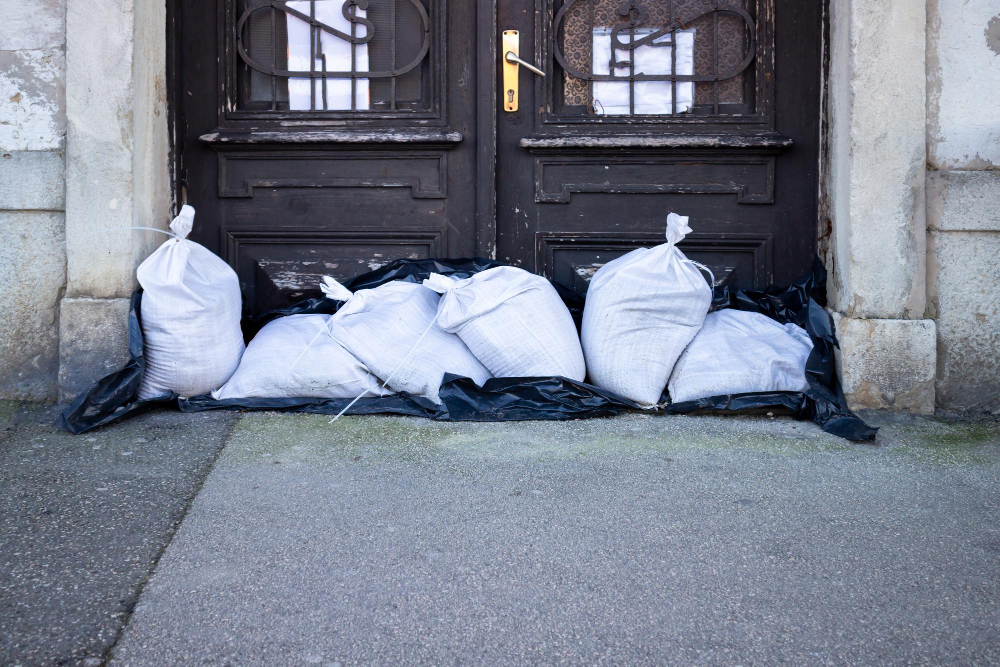
Nobody buys a sandbag expecting it to last. What catches crews out is how it fails, because a sandbag rarely quits all at once. It gives up a little at a time, quietly, while everyone assumes the sign is still held down. By the time anyone notices, the sign is in a traffic lane and the bag that was supposed to hold it is sitting empty on the shoulder. This is a look at what actually goes wrong, in the order it goes wrong, and why the same failures repeat on every site.
The Bag Is the Weak Part, Not the Sand
Sand does not fail. Sand is rock that has already been broken down as far as it goes, so it weighs what it weighs and it will still weigh that in a hundred years. The bag is the part that fails, which means everything that goes wrong with a sandbag is a story about fabric, and fabric on a job site has a hard life. Once you see it that way, the failures stop looking random and start looking inevitable.
Most sandbags are woven polypropylene, with burlap turning up on older stock. Both are cheap, both hold sand fine on day one, and both break down outdoors. The only question is how fast, and the answer depends on which of the following gets there first.
Failure One: Abrasion
This is usually the first one to hit. A sandbag on a sign base is not sitting still, because every gust rocks the sign and the bag grinds against whatever is underneath it. On a sign foot that means a metal edge, a weld seam, or a bolt head, and on the ground it means gravel, broken asphalt, or fresh grade.
Woven fabric does not handle that treatment well. The weave opens up at the contact point, threads part, and a hole starts, and at that stage it is small enough that nobody would call it a problem. Barricade duty is the worst case, because the device is large, it catches more wind, and it rocks harder, which is why crews who weight barricades with sand replace bags several times a season for this reason alone.
Failure Two: The Slow Leak
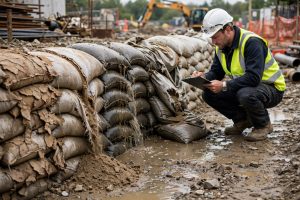
Once the weave opens, sand starts leaving, and this is the failure that matters most because it is the one nobody catches. It happens at roughly the speed of grass growing, a few ounces a day and a cup a week, and none of that looks any different from across the site.
A bag that held 40 pounds in March is holding 25 by August. The sign it is on has not moved, so nobody has any reason to check it. The crew drives past every day and sees a sign standing upright with a sandbag on the base, which is precisely what a working setup looks like. Then a real gust comes through, 25 pounds is not enough, and the sign goes down. The investigation afterward finds a bag with a hole in it, and that bag had been failing since spring.
This is why sandbag failure is a safety problem rather than only a cost problem. The setup looks compliant right up until it is not, and there is no warning built into it anywhere.
Failure Three: Water
Rain does two things to a sandbag and neither of them helps. The obvious one is weight, because wet sand is heavier than dry sand, and while that sounds like an improvement it means the bag is now carrying more load than the fabric was ever rated for. A bag already thinned by abrasion tears faster once it gets heavy.
The second is rot. Water sits in the weave, and burlap rots outright while polypropylene handles moisture better but still loses. Constant wet and dry cycling works the fibers loose, and a bag that has been soaked and dried twenty times is not the bag it was when it arrived.
The worst version of this is storage. A crew pulls wet bags off a site at the end of a job, throws them in a trailer, and closes the door, and six months later that trailer is full of moldy, brittle bags that go straight into a dumpster. Every one of those was paid for twice, once to buy and once to haul away.
Failure Four: Sun
Sunlight breaks down polypropylene, which is neither controversial nor slow enough to ignore. UV exposure makes the fibers brittle, so a bag that was flexible coming out of the box turns stiff and chalky after a season in the open. You can feel it by squeezing one, and bending it will crack the fabric where a new bag would fold.
A brittle bag does not survive being picked up, let alone being dragged across asphalt during teardown. Plenty of bags die in the hands of the crew removing them, which at least is a visible failure that nobody has to investigate. The bags that die quietly on site are the ones that cause the real problems. UV-treated bags last longer than untreated ones, but they lose eventually too, because sun is patient and the bag is not going anywhere.
Failure Five: Freeze & Thaw
Cold sites add another cycle on top of everything else. Wet sand freezes into a solid block and expands as it does, so the bag holding it is now under pressure from the inside at exactly the moment the fabric is cold, stiff, and least able to stretch. Seams open under that pressure and weaves split, because there is nowhere else for the force to go.
Then it thaws, the sand loosens, and whatever opened during the freeze becomes a path for sand to escape as the mass resettles. Run that cycle a dozen times over a winter and the bag is finished, which is why crews in cold climates learn to write off their sandbag stock every spring without ever quite investigating why.
Failure Six: The Shape Problem
This one is different from the others, because it is not about the bag wearing out at all. It is about the bag never having been the right tool in the first place.
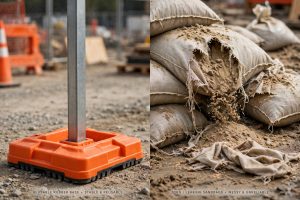
A sandbag is a loose sack, so draping it over a sign foot does not grip anything. It rests there, and the sand inside settles and redistributes, and the bag slumps and slides off center until after a few days it is sitting beside the foot rather than on top of it. Now the sign lifts in the wind and the frame comes up out from under a bag that is no longer on it, so the bag stays on the ground and the sign goes over. That bag might have been completely full and completely intact and it still failed, because a weight that is not connected to the base is not holding the base. No amount of better fabric fixes this one, because the geometry itself is wrong.
Failure Seven: Water That Does Not Drain
Standing water is where everything above stacks up at once. A shoulder floods and the bag is now sitting in six inches of water, and if it has leaked at all there is air space inside it, so it floats and drifts away. If it is still full it slides on wet pavement instead. Either way the sign it was holding is loose in the exact conditions where a loose sign in a roadway is most dangerous. Storm season is when weights matter most and when sandbags are least able to do the job, and that combination is what pushes most crews to start looking for something else.
What All of This Costs
Add it up across a year and the number stops being small. Bags get bought, filled, and hauled, then replaced as they tear, which on barricade work can happen several times a season. Crews stop mid-shift to top off leaks, and that labor gets billed to something while producing nothing. Wet stock gets thrown out at the end of the year and bought again in the spring, and the sand itself has to be stored somewhere and moved every time it is needed.
Then there are the failures that never appear on any invoice. A sign down in a live lane means a callout, and possibly a citation or a claim, and that single event can cost more than a full set of weights that would not have failed in the first place. Sandbags are cheap on the purchase order and expensive everywhere else, and that gap is the whole argument.
What Actually Fixes It
Every failure above traces back to two facts. The bag is fabric, and the bag does not grip. Fix both and the problem goes away, because a solid weight has no fabric to abrade, no weave to leak through, nothing to rot, nothing to go brittle in the sun, and nothing inside it to freeze and split it open. A weight molded to fit the base grips the sign rather than resting near it, which closes the last gap.
The Stand Box was built around exactly that. It is 30 pounds of solid compressed recycled rubber, so there is nothing to leak and nothing to refill. The base is molded with dual channels that fit over the feet of temporary road signs and fencing, so the weight locks onto the frame and the two move together. It will not float, it does not rot, and it does not care about sun or frost, and it weighs 30 pounds the day it arrives and 30 pounds years later. It was designed by Jodi Carter after years of replacing broken sandbags at a traffic control company in Colorado, which is a polite way of saying it was designed by someone who had every one of these failures happen to him personally.
The Takeaway
Sandbags fail because they are fabric bags full of loose material, sitting outside, in the weather, getting ground against metal. That is not a manufacturing defect and it is not bad luck. That is the design working as intended, for as long as it can manage.
For short dry jobs they are still fine and there is no reason to spend more on the alternative. For anything that has to stand through weeks of weather, the failures above are not a risk to be managed, they are a schedule, and the only open question is which one arrives first.